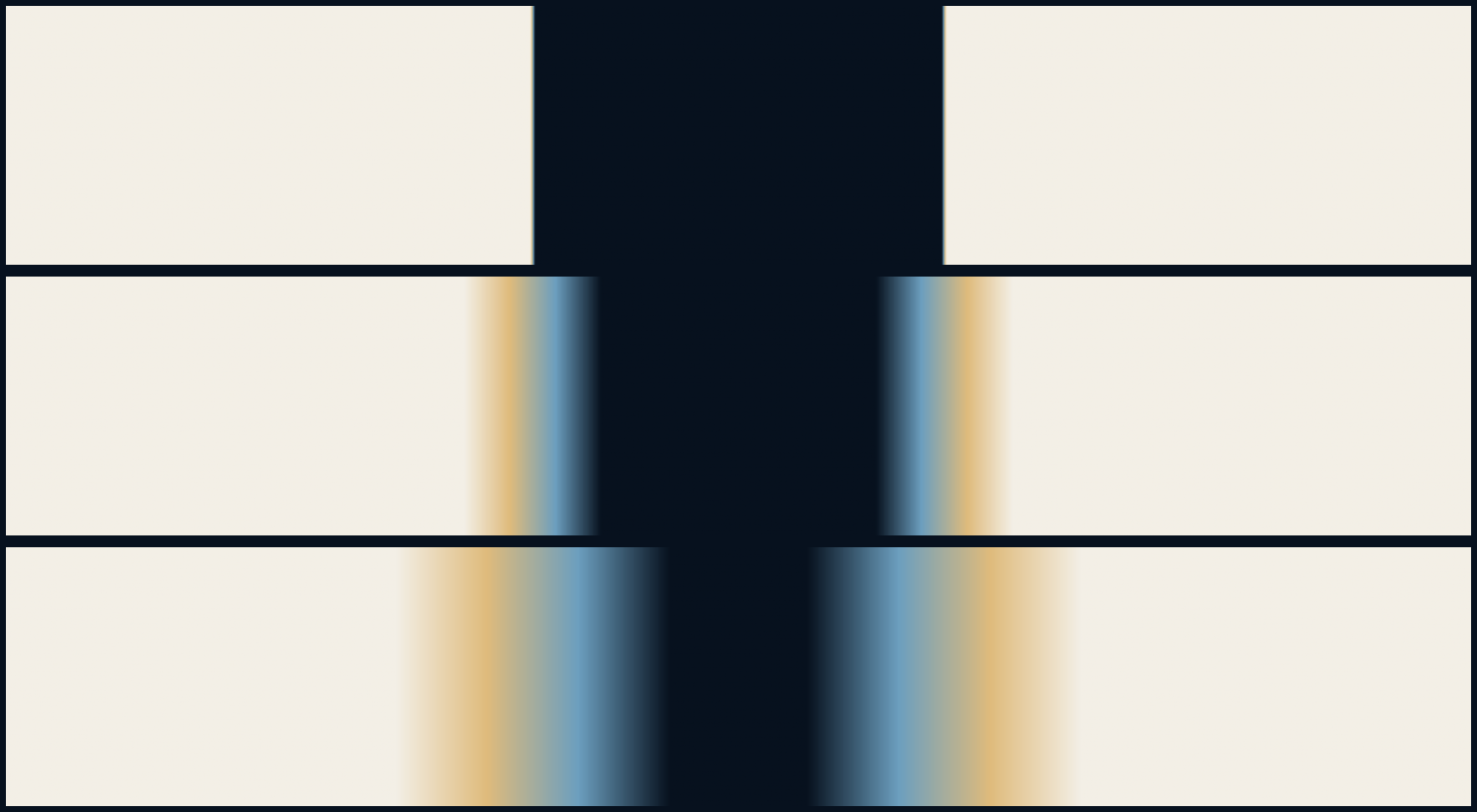
Why does the same object cast a crisp shadow under one light and a gentle one under another?
A shadow is a map of which light paths reach a surface. With a tiny source, the source is mostly either visible or blocked. With a broad source, an obstacle can hide only part of it. The gradual change in visible source area produces the penumbra: a boundary made of partial illumination.
A soft edge is a record of a partly visible light.
Look back toward the lamp
Imagine standing at one point on a receiving surface and looking toward a lamp. If an opaque obstacle hides the whole source, the direct contribution is absent. If the whole source is visible, that contribution is available. Between those situations, only some parts of the source can send unobstructed rays to the point.
This visibility explanation does not require the object itself to be translucent or fuzzy. The obstacle in our model has a perfectly sharp boundary. The softness comes from the source having extent, so different rays encounter different sides of the same edge.
A small cross-section makes the rays readable
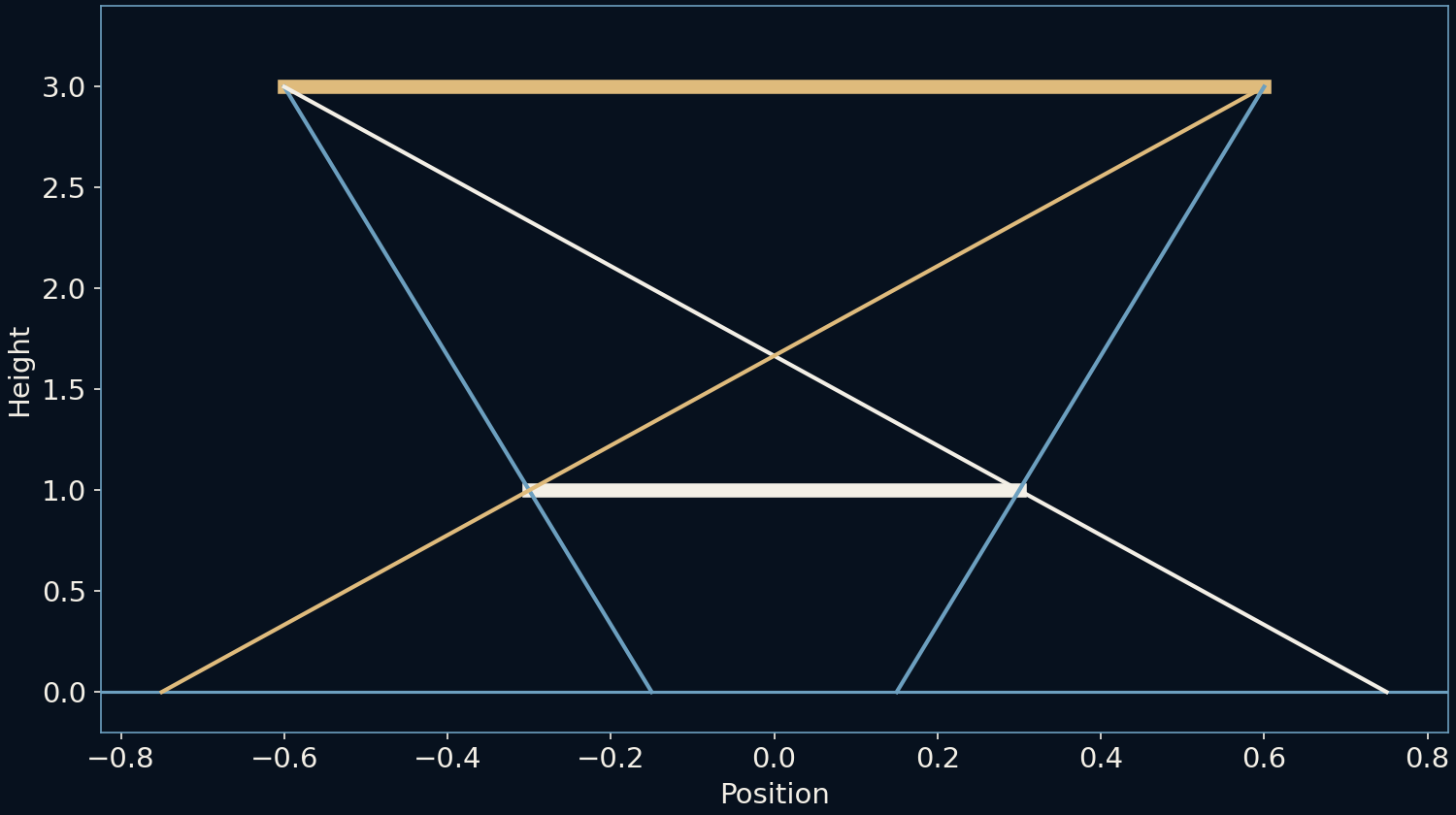
The calculation uses a two-dimensional cross-section. A horizontal line emitter sits at height three, an opaque blocker at height one, and the receiver at height zero. The blocker is 0.6 units wide. We test emitter widths of 0.02, 0.6 and 1.2 units while keeping every other dimension fixed.
For each receiver position, 1,001 evenly spaced source points send candidate rays toward it. A ray is blocked when its intersection with the blocker’s height falls inside the blocker. The fraction that remain visible becomes the plotted value. It is a normalized visibility calculation, not a full radiometric renderer.
The larger source draws a wider transition
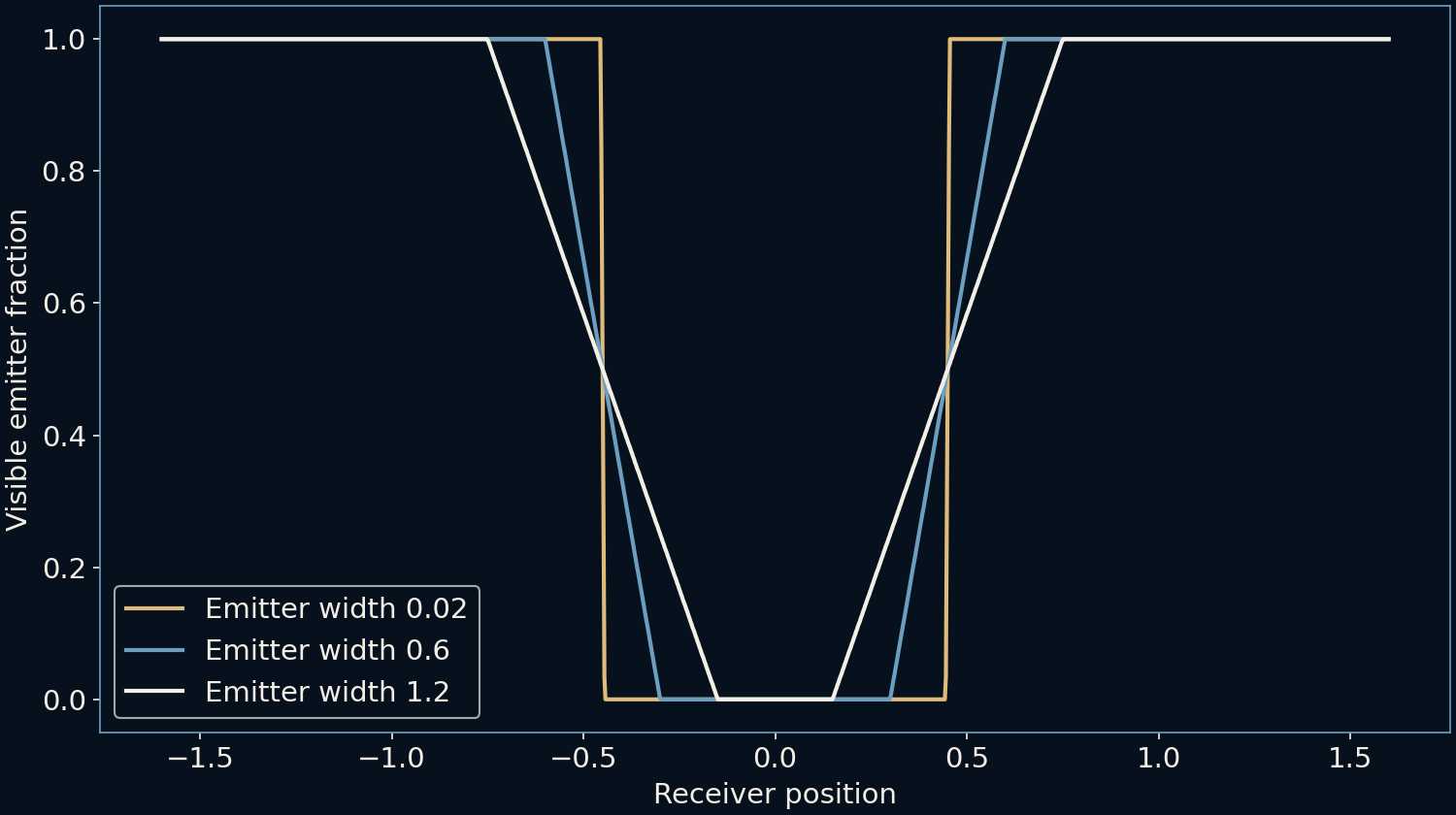
The nearly pointlike 0.02-unit emitter produces a narrow boundary. The wider emitters create visibly broader transitions. In this geometry, one edge’s penumbra width equals the source width multiplied by the blocker-to-receiver distance and divided by the source-to-blocker distance. Those distances are one and two units.
The resulting predicted widths are 0.01, 0.3 and 0.6 units. The plotted ray construction shows why: rays from opposite source edges touch the same blocker edge and reach different receiver positions. Increasing the source width separates those limiting rays farther apart.
Softness depends on placement too
Moving the blocker toward the receiver reduces the distance over which those limiting rays spread. A contact shadow can therefore be relatively crisp even under a broad light. Moving it away from the receiver can broaden the transition, provided the other geometry is held appropriately fixed.
In everyday descriptions, a large light often means a light that occupies a large angle from the object’s position. Physical size alone is insufficient. A large source very far away can subtend a small angle. Our example varies source width at a fixed distance precisely to avoid mixing these different changes.
Visibility is only one part of brightness
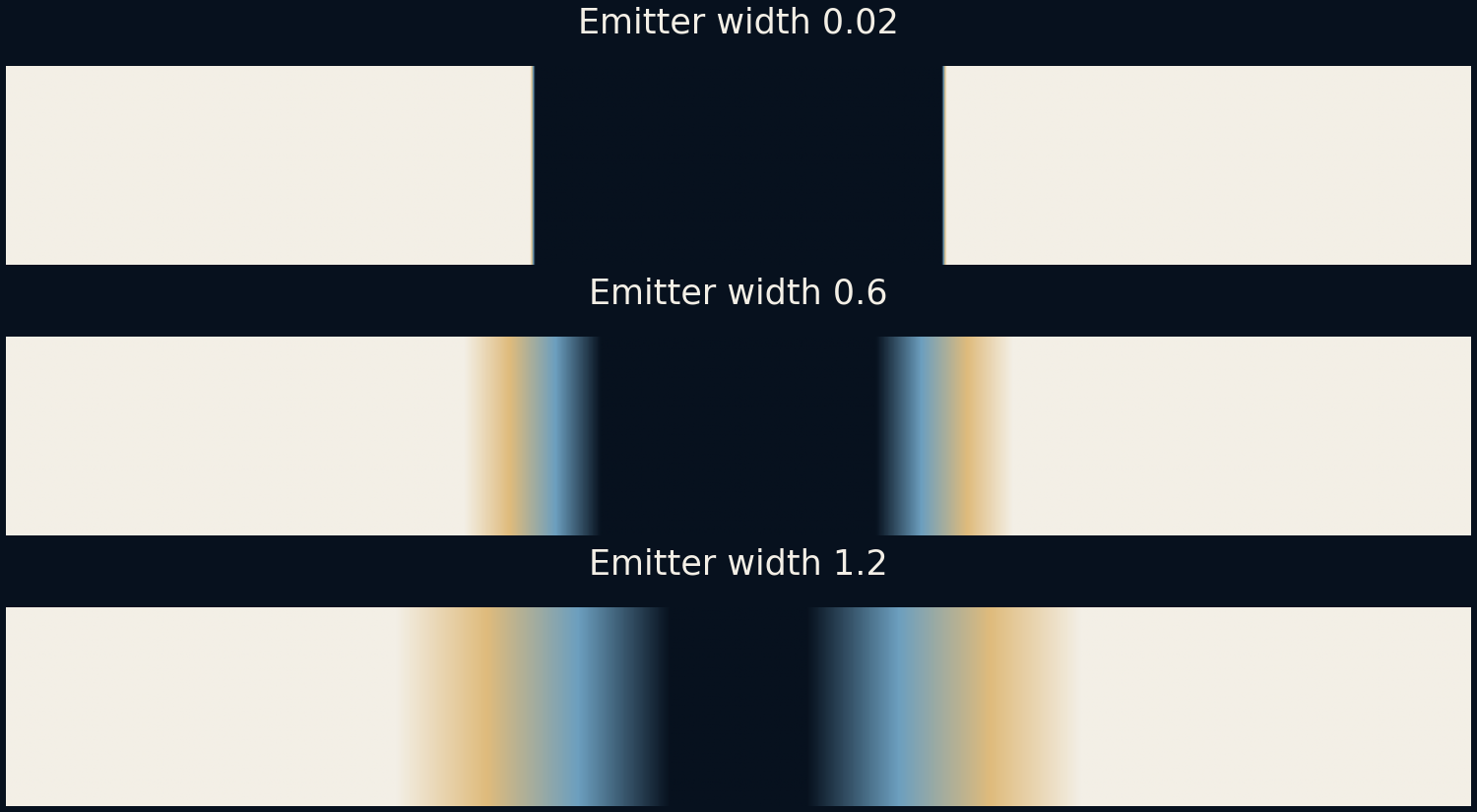
The model gives every emitter sample equal weight. Real illumination also depends on emission, distance, surface orientation and the geometry of a two-dimensional emitting area. Indirect light can brighten the nominally blocked region, and multiple sources can overlap several shadows. The figure should therefore be read as a visibility profile. A line source produces an approximately linear ramp across each isolated edge here. A circular or rectangular area source can produce a differently shaped transition because the visible portion changes with two-dimensional area rather than with line length.
A camera adds its own exposure, tone mapping and sampling. A dark-looking shadow need not have zero physical illumination, and a soft photographed boundary may include defocus or motion. This experiment isolates one mechanism: partial occlusion of an extended source by a sharp, opaque object.
Read a shadow as a clue to the room
The boundary can suggest the apparent size of the source and the spacing between object and surface. It does not uniquely determine either one without more information. Two different arrangements can produce similar widths. The full shadow shape also depends on the object’s outline and on where the receiving surface bends.
For drawing or lighting a simple scene, the useful question is which parts of the source each point can see. That question gives a concrete explanation for the smooth transition and avoids treating softness as an arbitrary blur painted over a dark silhouette. The rays already contain the edge.
Further reading
Physically Based Rendering: area lights ↗OpenStax: the ray aspect of light ↗Original documentation and useful background.