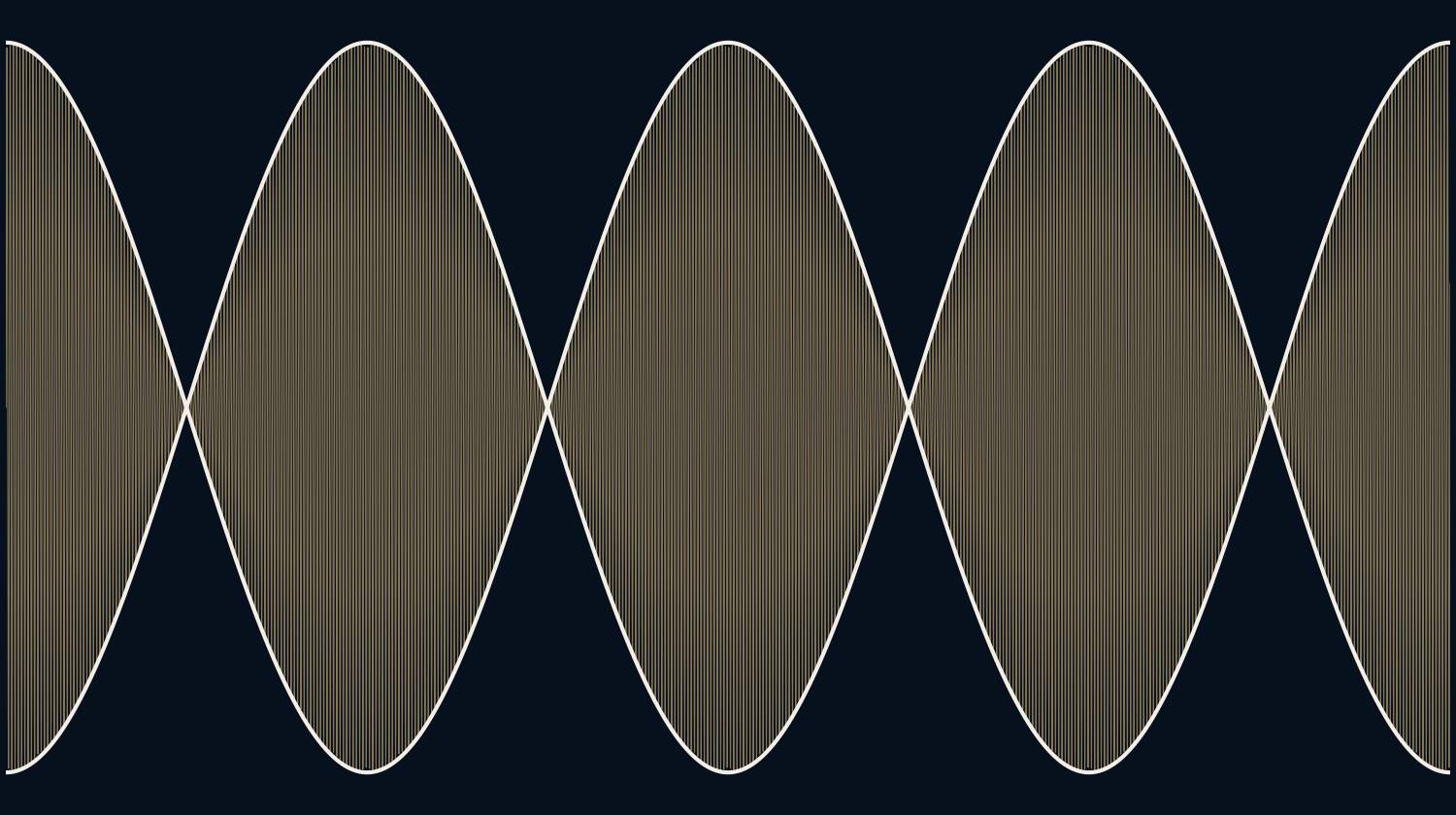
How can two steady tones create a rhythm that neither plays alone?
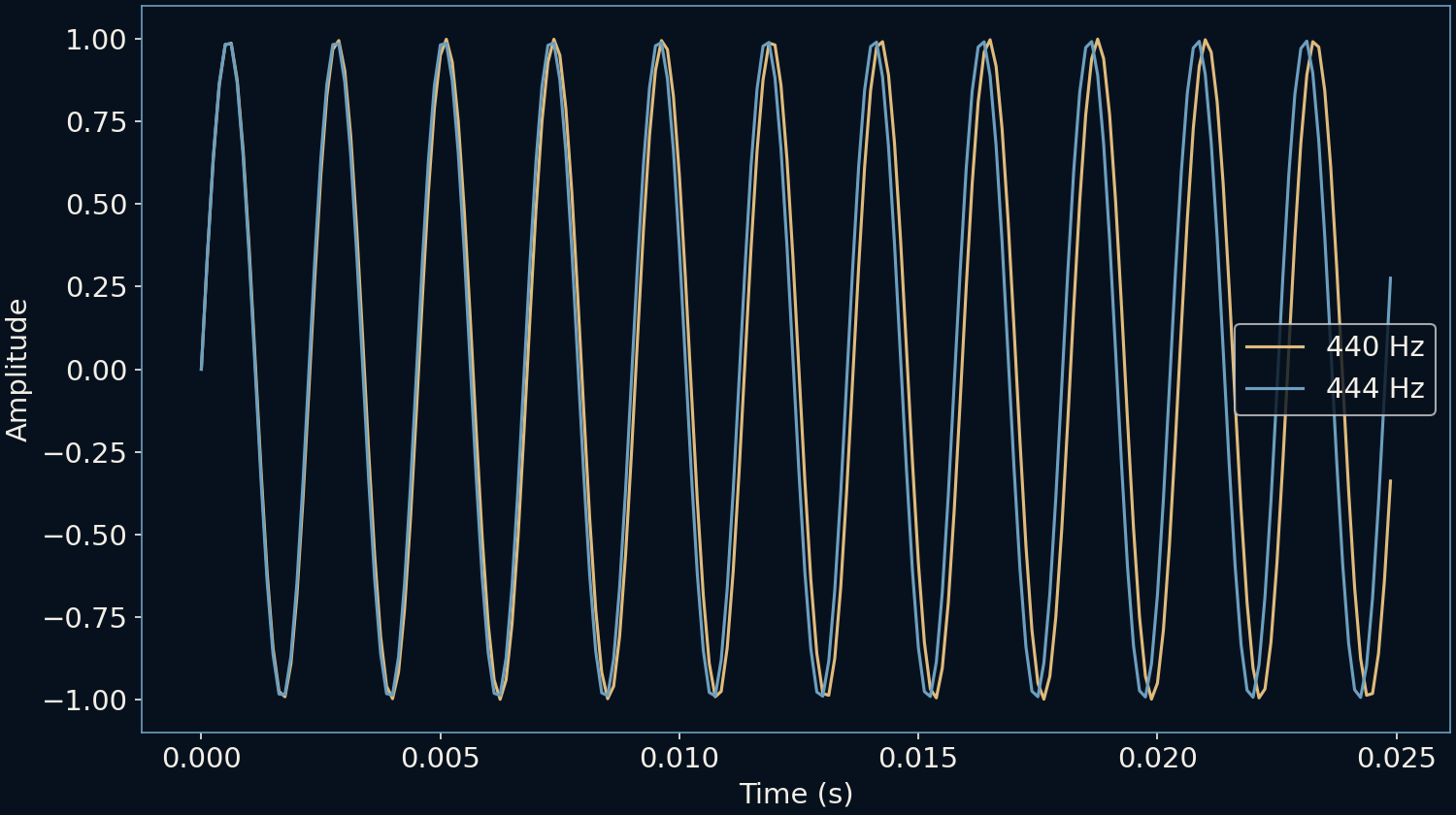
A 440 Hz sine wave and a 444 Hz sine wave each repeat hundreds of times per second. Add them, and their combined amplitude swells four times per second. The slow pulse comes from their changing alignment. This familiar beat effect is especially clear when the ingredients are simple and their amplitudes are equal.
A slow envelope can ride on two fast oscillations.
The waves keep meeting and separating
At one moment, the two sine waves push in nearly the same direction. Their values add constructively. A little later, one is ahead of the other, and their contributions partly cancel. Because the frequencies differ, the relative phase keeps moving rather than staying fixed.
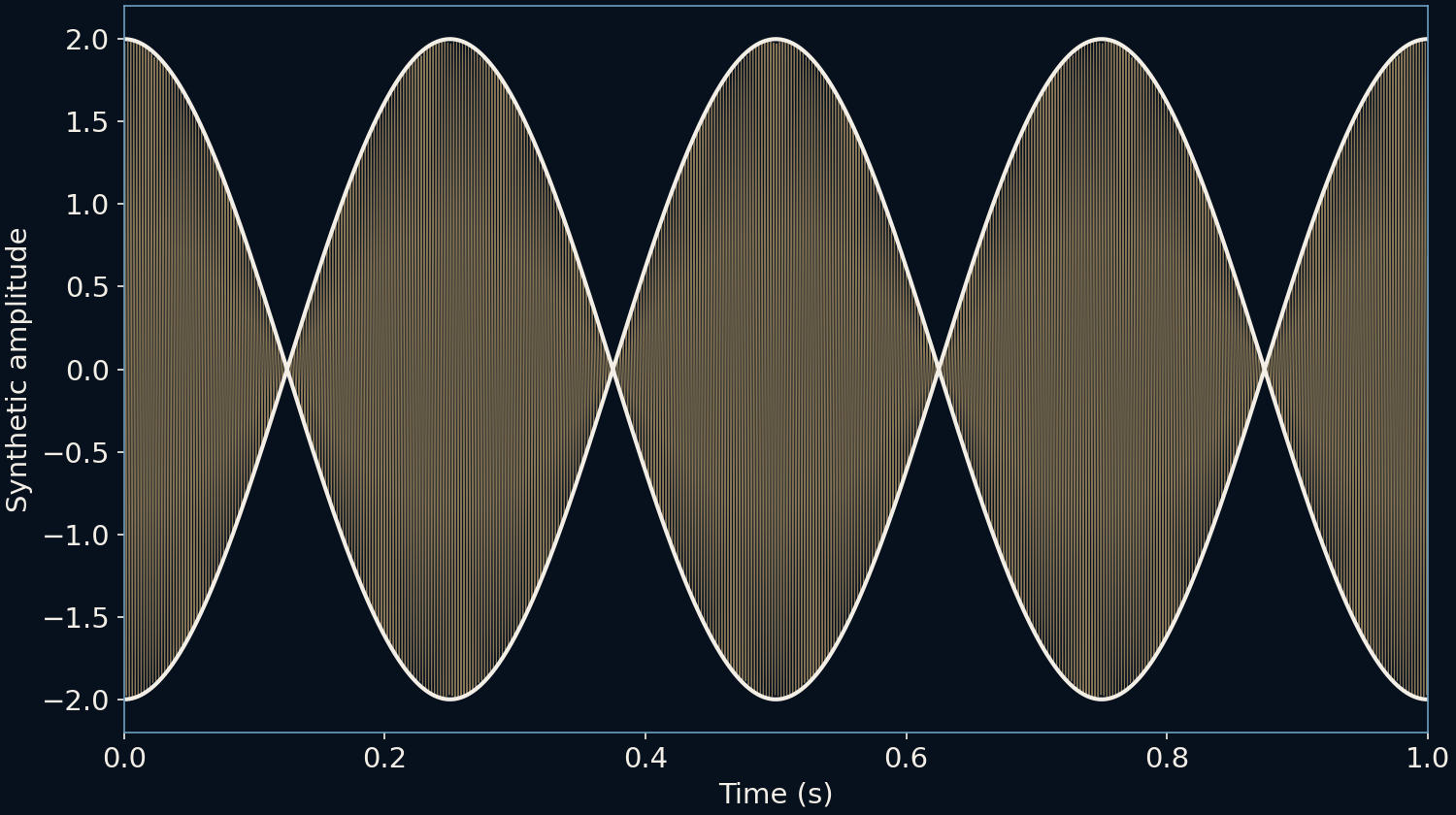
Our signal is generated directly from sine formulas at 8,000 samples per second. It lasts two seconds and contains no microphone recording. Each component has amplitude one, so the mixture can approach amplitude two. Those units are arbitrary numerical amplitude, not calibrated air pressure or a recommended playback level.
A useful identity separates the motions
Adding equal-amplitude sine waves at 440 and 444 Hz can be rewritten as a 442 Hz sine multiplied by a slowly varying cosine factor. The signed factor is twice a cosine at 2 Hz. Taking its absolute value gives the nonnegative amplitude envelope drawn around the rapid oscillation.
Why, then, are there four beats per second rather than two? Both positive and negative maxima of the signed factor produce a large absolute amplitude. The sign reversal changes the fast oscillation’s phase, while the magnitude swells twice during each cycle of the 2 Hz factor.
Read the envelope, then the spectrum
The white boundary reaches a maximum every quarter second, matching the four-hertz difference between the source frequencies. It reaches zero between those maxima in the ideal equal-amplitude case. The rapid waveform stays within this boundary, which makes the slower pattern easy to inspect visually.
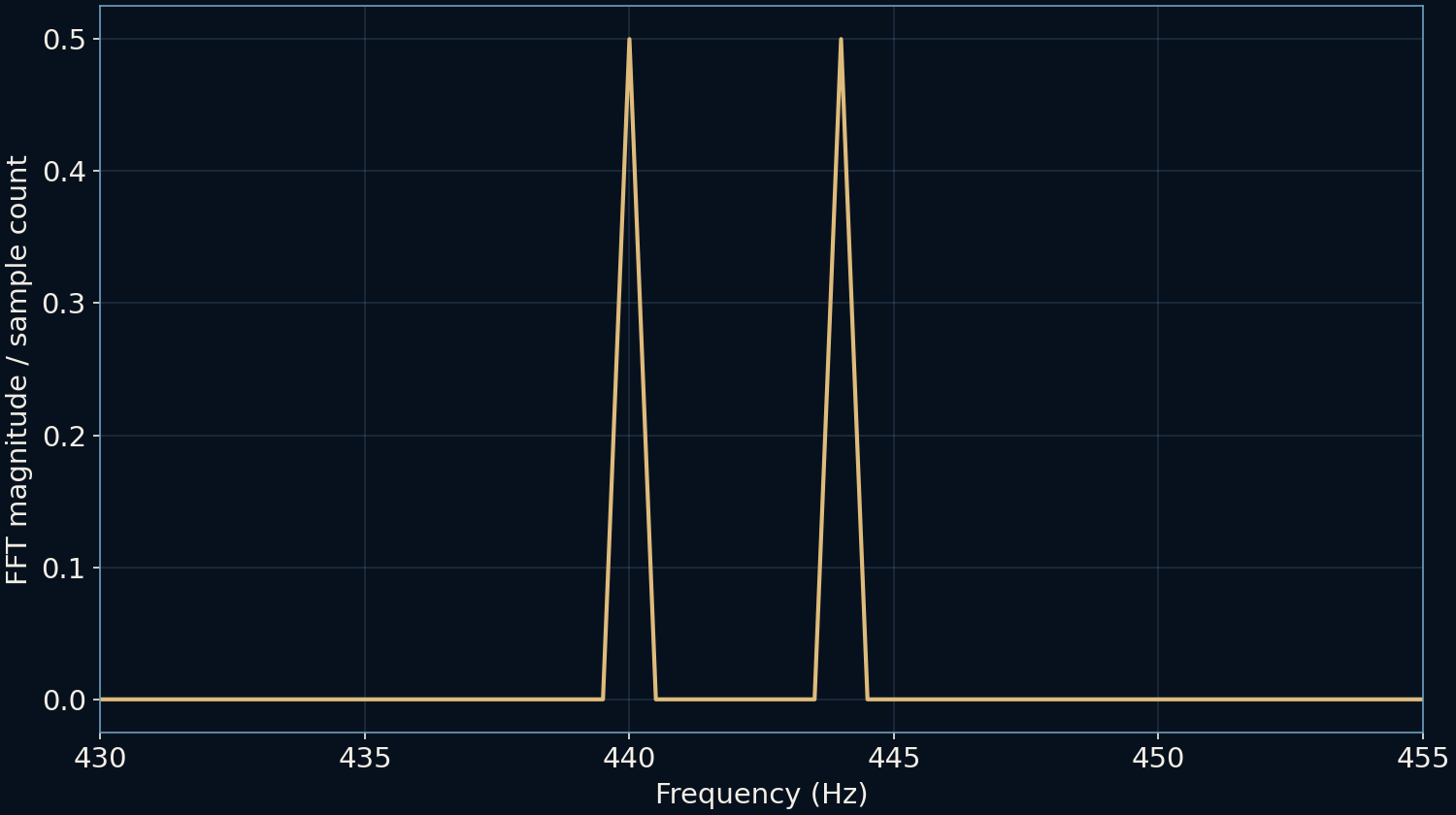
The Fourier spectrum nevertheless contains peaks at 440 and 444 Hz, not a separate four-hertz sinusoidal component. A changing amplitude envelope and an added low-frequency spectral line are different descriptions. The slow rhythm emerges in the magnitude pattern of the sum; our linear addition has not manufactured a third pure tone. The record contains exactly 880 cycles of one tone and 888 of the other. Both frequencies land on Fourier bins, so this particular rectangular record avoids the leakage that would appear if its endpoints cut those tones at incompatible phases.
Equality makes the quiet moments complete
If the component amplitudes differ, the stronger wave cannot be fully canceled by the weaker one. For amplitudes A and B, the envelope ranges between their absolute difference and their sum. The rate of the beat remains tied to the frequency difference in this simple two-tone case.
Real instruments contain harmonics and fluctuating amplitudes, and acoustic reflections add more contributions. Their mixtures can produce several patterns at once. The clean zero-amplitude moments in our figure therefore illustrate a special controlled case, not a promise that two real instruments will periodically become silent in a room.
The ear is not a waveform plot
For nearby tones, the changing amplitude can be heard as a slow fluctuation. As separation increases, the perceptual result changes and depends on frequency, level and the listener. The numerical envelope alone is not a complete model of roughness, loudness or musical consonance.
The article intentionally provides static diagrams rather than making claims from a listening test. It does not infer hearing ability or acoustic safety. A mathematical sum can explain where a modulation comes from while leaving the perceptual question open. That boundary is important whenever an audio visualization looks more definitive than the underlying experiment.
A small difference can become easy to notice
The beat mechanism is useful when comparing nearly matched periodic signals. A small frequency difference that is difficult to inspect cycle by cycle becomes a much slower variation. Musicians can use audible beats as one clue when adjusting sustained tones, though real tuning involves timbre and musical context too.
The larger lesson is about superposition. Adding signals can create a striking pattern in their combined shape without adding a new ingredient to the linear spectrum. Looking at both the waveform and its frequency components helps keep those two kinds of explanation from being confused.
Further reading
OpenStax University Physics: beats ↗NumPy: real-input Fourier transform ↗Original documentation and useful background.