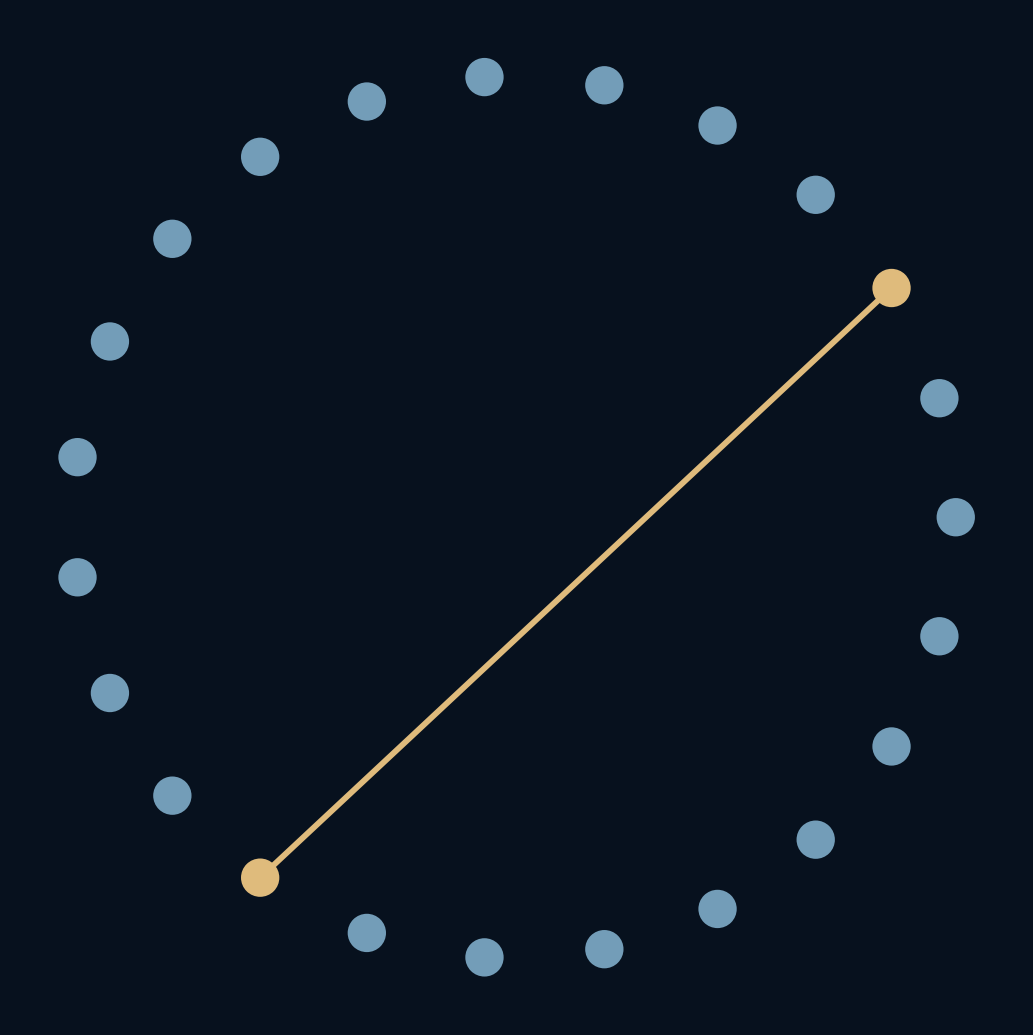
Nobody has to share your birthday for the room to contain a match.
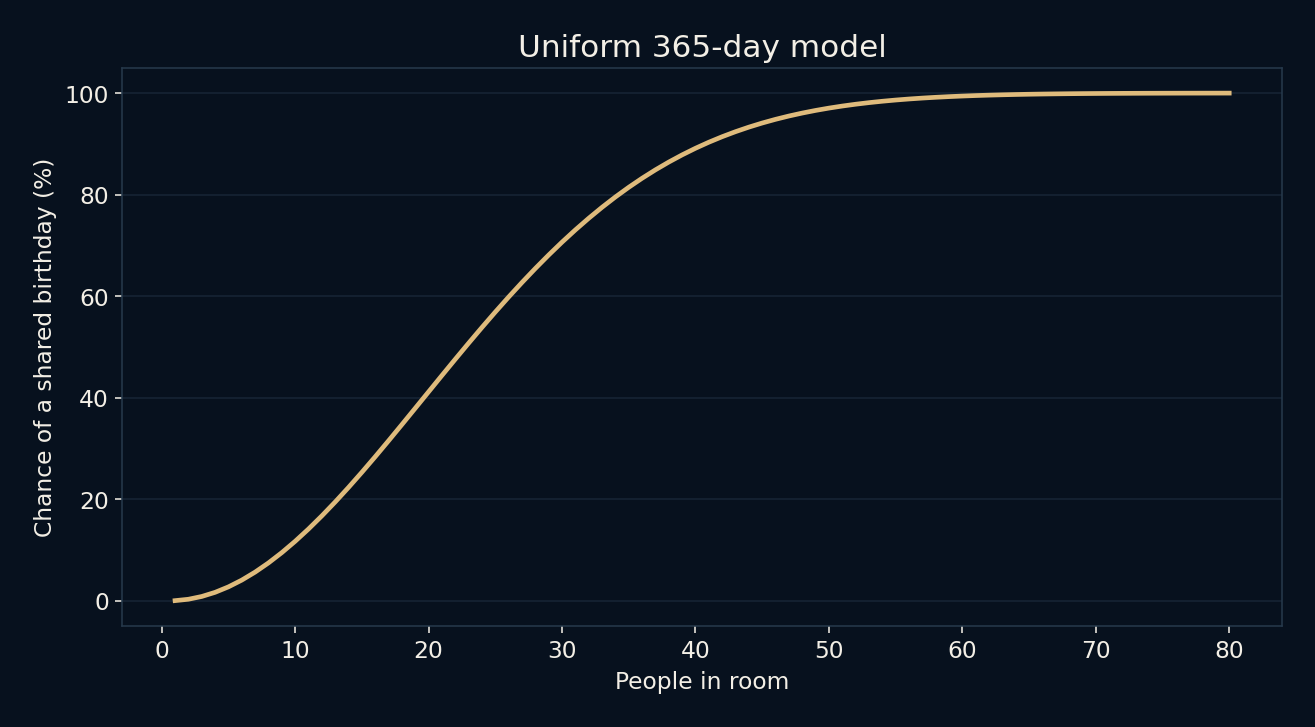
Imagine a room whose guests have independently chosen birthdays from 365 equally likely days. This deliberately simplified world leaves out leap days, seasons and families. Even here, with no special connection between anyone, a shared birthday becomes more likely than not at just 23 people. The room feels small because we count people. The event we are asking about depends on pairs.
Count the opportunities for a coincidence, not just the people.
Your match and any match are different events
If you stand in the room and ask whether someone shares your own birthday, there are 22 possible partners. Each offers a small chance of a match. But the familiar birthday question lets every guest match every other guest. A pair at the opposite side of the room counts even when neither birthday resembles yours.
With 23 people there are 23 × 22 ÷ 2, or 253 distinct pairs. Division by two prevents counting Alice with Ben and Ben with Alice as separate pairs. That is a much larger collection of opportunities than 22. The pair count explains the surprise, although multiplying 253 by 1/365 would not give the exact probability: matching events can overlap.
It is easier to count a room with no match
Give the first person any birthday. For the second to avoid a match, 364 of 365 days remain available. The third must avoid two occupied days, leaving 363 possibilities. Continue this chain: the probability that all birthdays differ is the product of these successive fractions. Subtract that product from one to get at least one shared birthday.
The exact result for 23 people is 50.7297%. At 40 people it is 89.1232%. These are probabilities of an event, not predictions of how many matching pairs will appear. A room with one pair and a room containing a triple both satisfy the same event. Keeping that distinction prevents a persuasive chart from quietly changing the question.
A simulation makes the event tangible
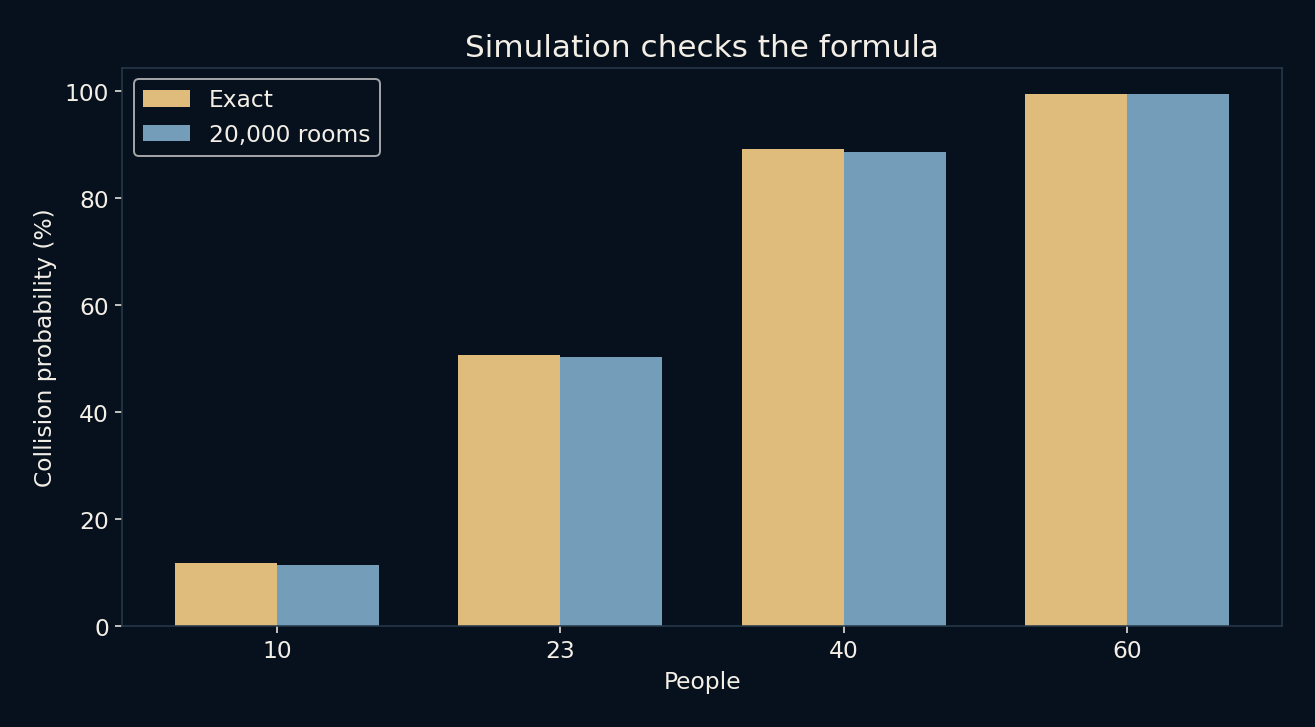
The local experiment generated 20,000 rooms at each of four sizes. Inside each room, it sorted the chosen birthday numbers and checked whether any neighbours were equal. Sorting makes duplicates easy to detect; it does not change the birthdays. A fixed pseudorandom seed makes this particular exercise repeatable.
At 23 people, 50.275% of simulated rooms contained a match, compared with the exact 50.7297%. At 40, the measured fraction was 88.72%. A simulation is not expected to copy the formula digit for digit. Each finite collection of rooms introduces sampling variation, and a different random stream would give slightly different fractions.
Real birthdays do not fill a perfectly even calendar
The calculation assumes independent guests and equal probabilities for all 365 days. Actual birthdays have seasonal patterns, and selecting relatives or twins can introduce dependence. February 29 also requires a choice about what counts as a matching birthday. None of those details appears in this experiment.
Uneven day probabilities can make pairs more likely to match than in a uniform calendar with the same number of days. Dependence is more complicated and must be described rather than guessed. The useful habit is to write down the sampling rule before interpreting the percentage. A tidy mathematical answer can be exact for a model while remaining an approximation to a real gathering.
Many chances make a rare event less rare
The same counting instinct helps when thinking about repeated identifiers, accidental similarities or a large collection of comparisons. A tiny probability for one chosen pair says little until you know how many pairs have a chance to meet. Larger systems can accumulate opportunities much faster than their item count suggests.
That analogy does not turn this birthday calculation into a security guarantee or a diagnosis of suspicious coincidences. Different systems have different outcome spaces, dependencies and consequences. Here the modest lesson is enough: before declaring a coincidence astonishing, ask how many opportunities there were to notice one. The answer often changes the feeling of the event.
Further reading
OpenStax: probability rules and complements ↗NumPy: uniform integer sampling ↗Python: products with math.prod ↗Original documentation and useful background.