
Why does a white patch stay empty when you turn the brightness down?
A bright window can contain curtains, reflections and textured clouds. In a photograph it may become a featureless patch. The problem is not always that the image looks too bright. Several different amounts of incoming light may already have been recorded as the same maximum number, and a later edit sees only that shared number.
A smaller number cannot restore a lost distinction.
A ceiling changes the information
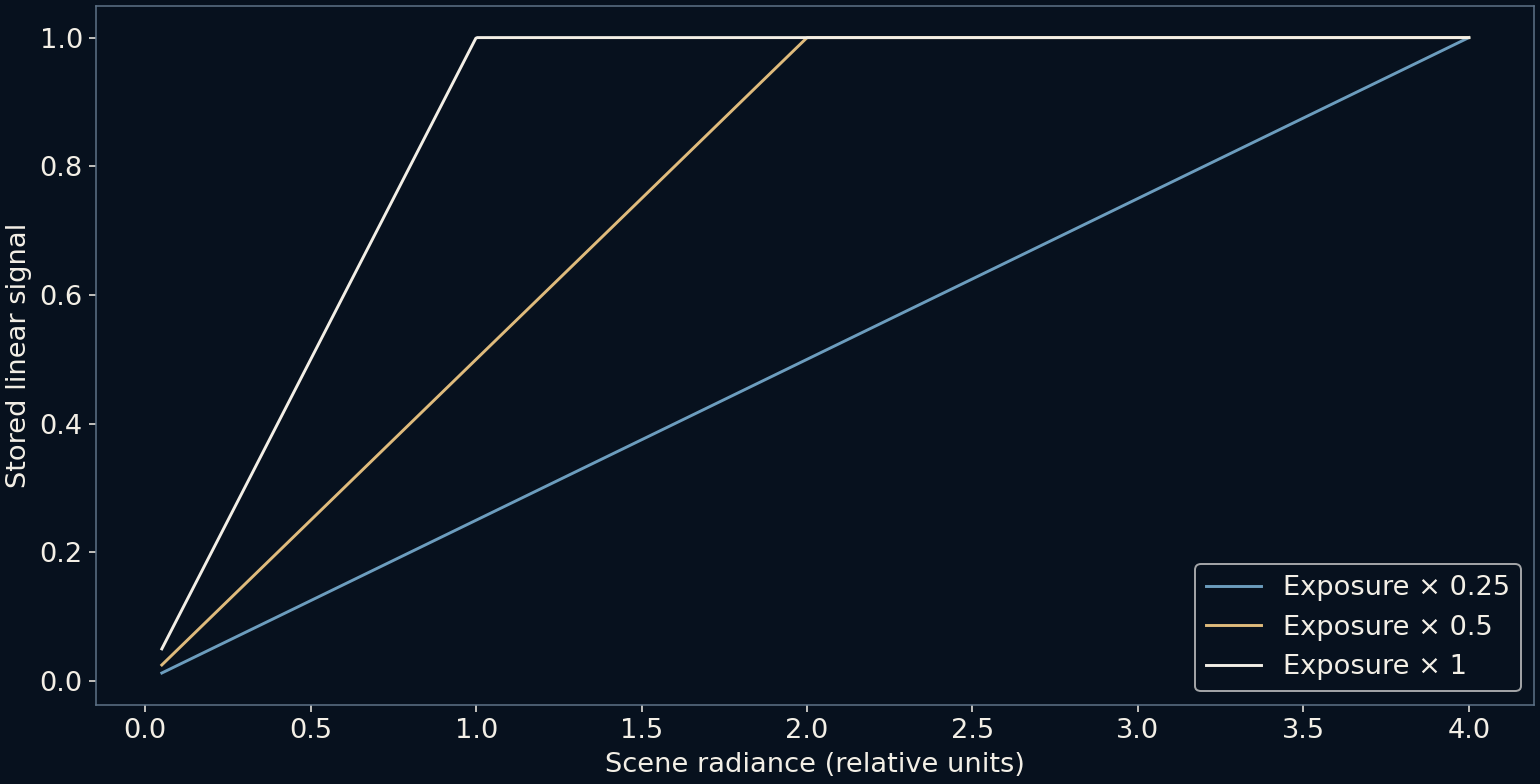
The calculation uses a simple linear sensor-like response: multiply scene radiance by exposure, then limit the result to a maximum of one. Radiance here is in arbitrary relative units. We do not simulate an actual sensor, its electrons or its colour filters. The ceiling is enough to show the information loss.
At exposure one, scene values of two and three both become one. At exposure one quarter, they become 0.5 and 0.75. The shorter exposure preserves their difference in this ideal model. Once the first pair has been clipped, multiplying both stored ones by any common brightness factor still leaves them equal.
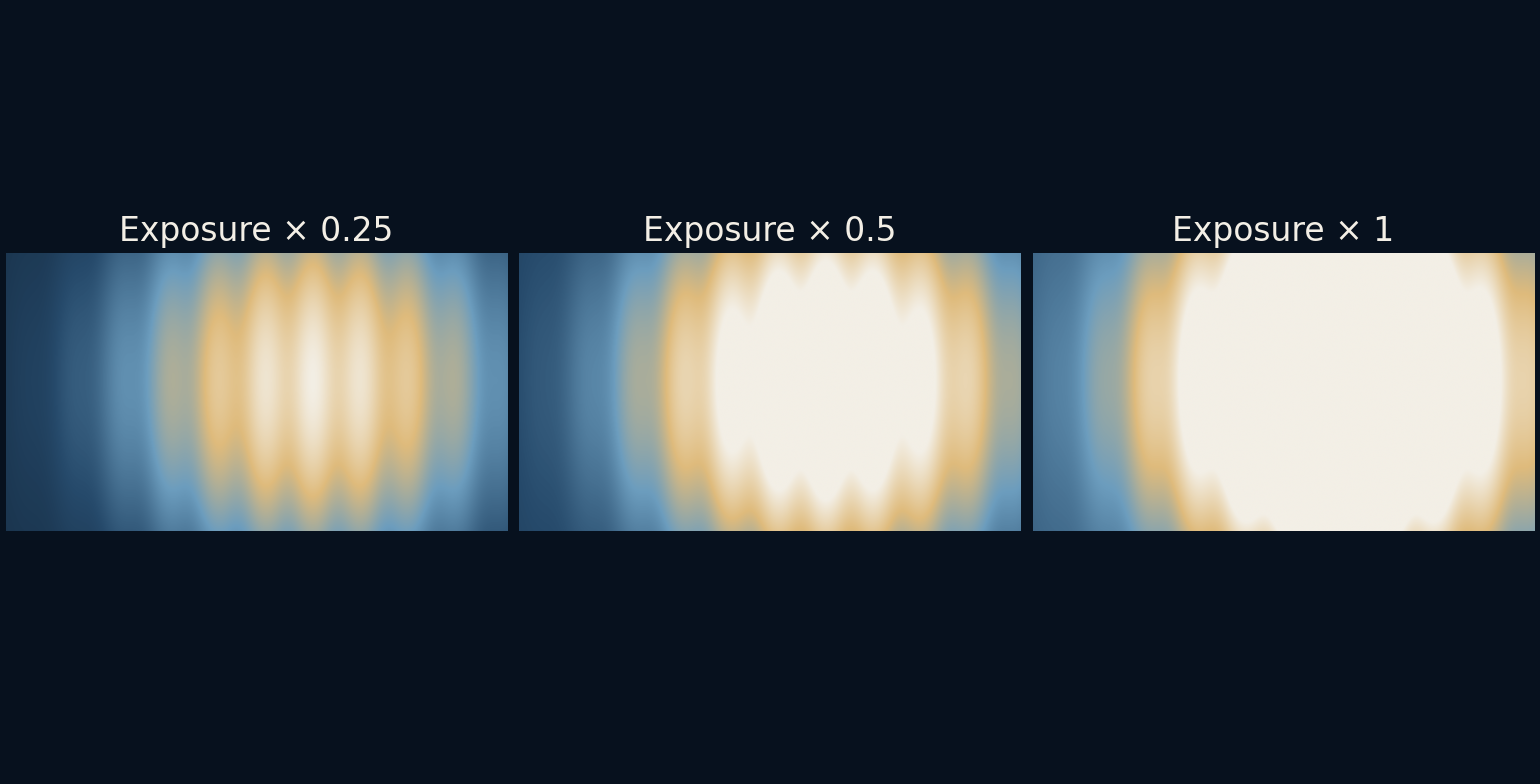
A textured highlight becomes a plateau
The illustrative scene contains a smooth bright mound with repeated texture across it. Three exposures use the same scene and the same display treatment. As exposure increases, a larger region reaches the maximum. The flattened region no longer contains the changes that described its stripes, even though the source calculation still has them.
The separate line experiment makes the threshold easier to measure. It samples 900 radiance values from 0.05 to four. At exposures 0.25, 0.5 and one, approximately 0.11%, 50.67% and 75.89% of samples reach the ceiling. The first percentage includes the endpoint exactly equal to one; it is not a claim that all those samples exceeded the limit.
Exposure and display brightness are different steps
Exposure affects how much light contributes to the capture. A later display adjustment changes the appearance of values already stored. If the stored values retain highlight distinctions, a suitable edit can reveal them. If all relevant channels have truly saturated, simply reducing brightness cannot reconstruct the missing scene differences from those values alone.
Raw files may contain more recoverable range than a rendered preview suggests, and one colour channel may clip before another. Software can sometimes estimate plausible detail from other information. That possibility should not be confused with measuring the original lost values. Our single-channel model deliberately leaves colour-channel recovery and proprietary processing out.
A curve can compress before information is lost
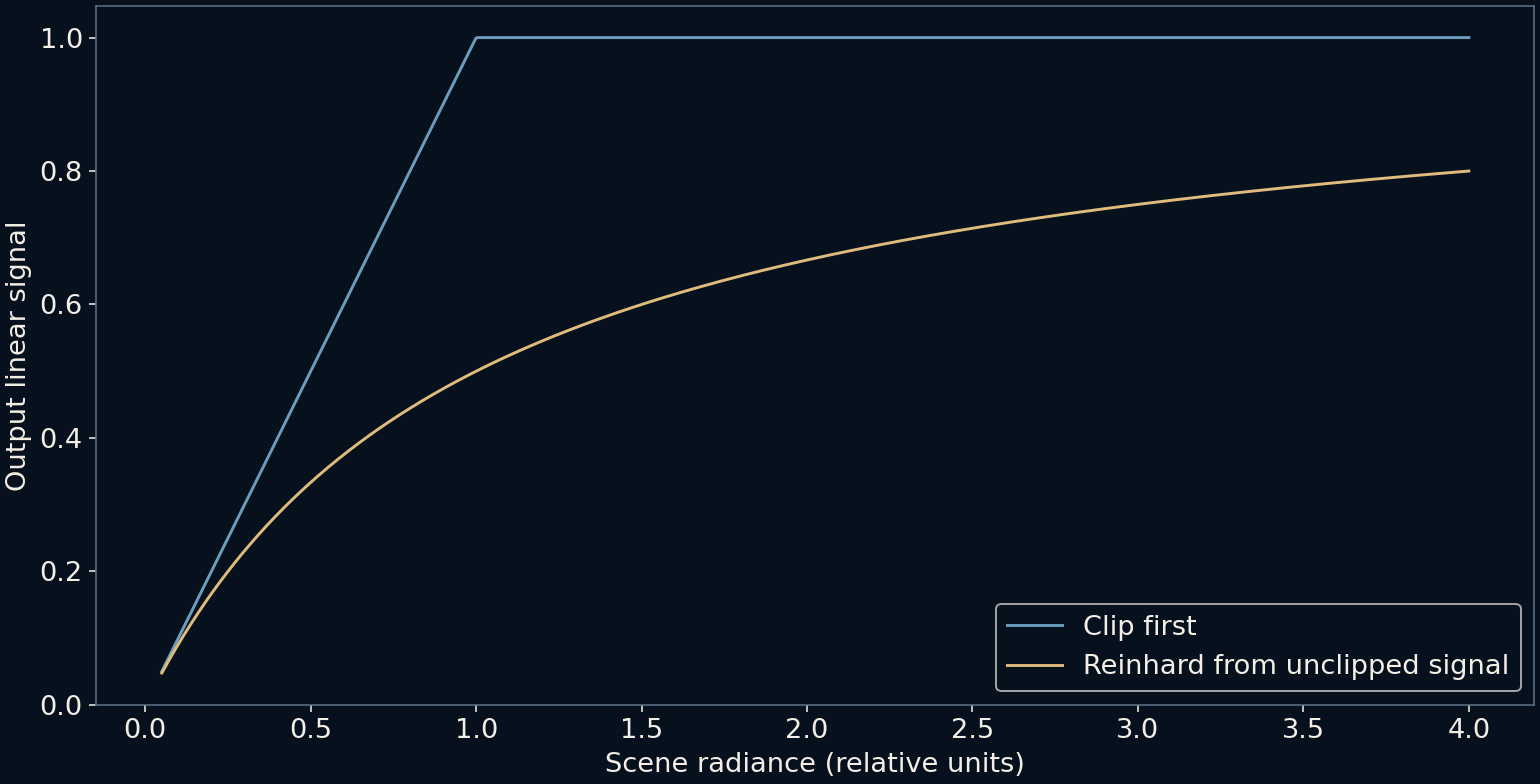
Tone mapping assigns a large input range to a smaller output range. The plotted example uses the simple function x divided by one plus x. It rises continuously without reaching one for finite positive inputs, so values two and three remain different, becoming about 0.667 and 0.75 respectively.
This only helps if the curve receives the unclipped values. Applying it after both inputs have become one gives the same output for both. The order of operations matters more than the sophistication of the adjustment. In a real pipeline, finite precision and noise can still make small remaining differences unusable even without a hard mathematical plateau.
Protecting highlights has a cost elsewhere
Reducing exposure can preserve bright regions while leaving darker regions with fewer captured photons and potentially poorer signal-to-noise performance. That trade-off is absent from our noiseless arrays, so the demonstration cannot prescribe a universally correct exposure. Scene contrast, motion, capture limits and the intended picture all matter.
Multiple exposures can extend captured range when they can be aligned appropriately, but moving subjects and changing light complicate the combination. A single image may intentionally let a light source become white. The useful distinction is between a deliberate visual choice and the mistaken belief that every apparently empty highlight can be recovered later.
Look for distinctions, not only brightness
A histogram pressed against an endpoint can warn of clipping, but its meaning depends on whether it represents raw data, a rendered image or a preview. Examine the relevant channels and the actual file rather than treating one small display as the entire capture. Our graph offers a simpler diagnostic: different inputs collapse onto a horizontal line.
That collapse is the heart of the problem. Editing can move a plateau up or down and can invent plausible texture, but neither operation proves that the missing distinctions were recorded. Before asking how to brighten or darken a photograph, ask which differences survived into the numbers available for editing.
Further reading
Adobe: Adjusting HDR exposure and toning ↗PBRT: Film and imaging ↗Original documentation and useful background.