
Can a forward-turning wheel leave exactly the same frames as a backward-turning one?
A filmed wheel sometimes seems to slow, stop or reverse while its vehicle continues moving forward. Nothing mechanical has reversed. A sequence of still pictures has offered an ambiguous account of the movement. Four identical spokes are enough to construct that ambiguity precisely, without filming a vehicle or relying on an optical illusion video.
Frames record positions, not the journey between them.
Identical spokes erase their names
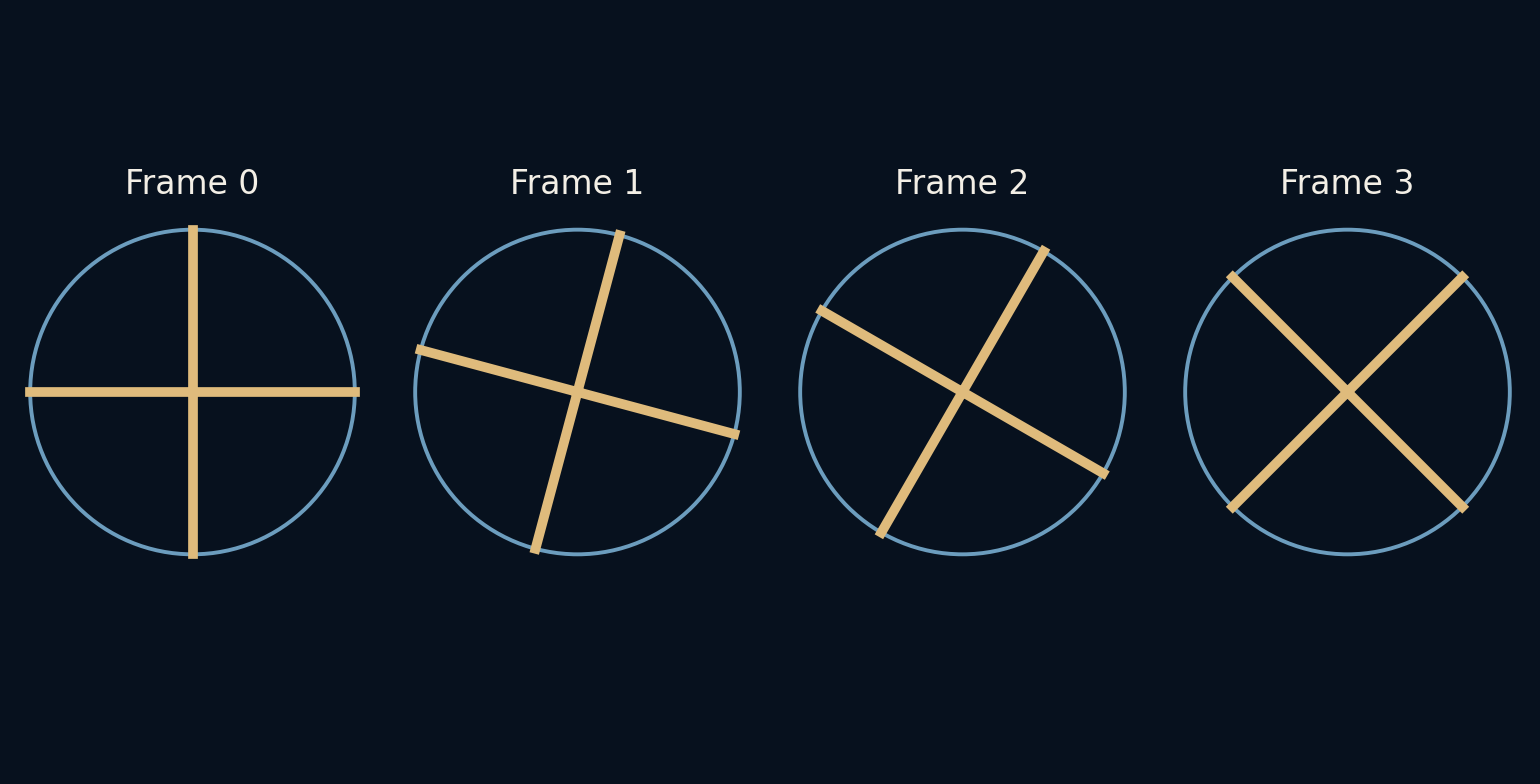
Our wheel has four evenly spaced, indistinguishable spokes. Rotate it by 90 degrees and the picture looks the same. A viewer cannot tell whether the spoke at the top is the original top spoke or its neighbour. That repeated appearance is the key; a clearly marked unique spoke would provide additional information.
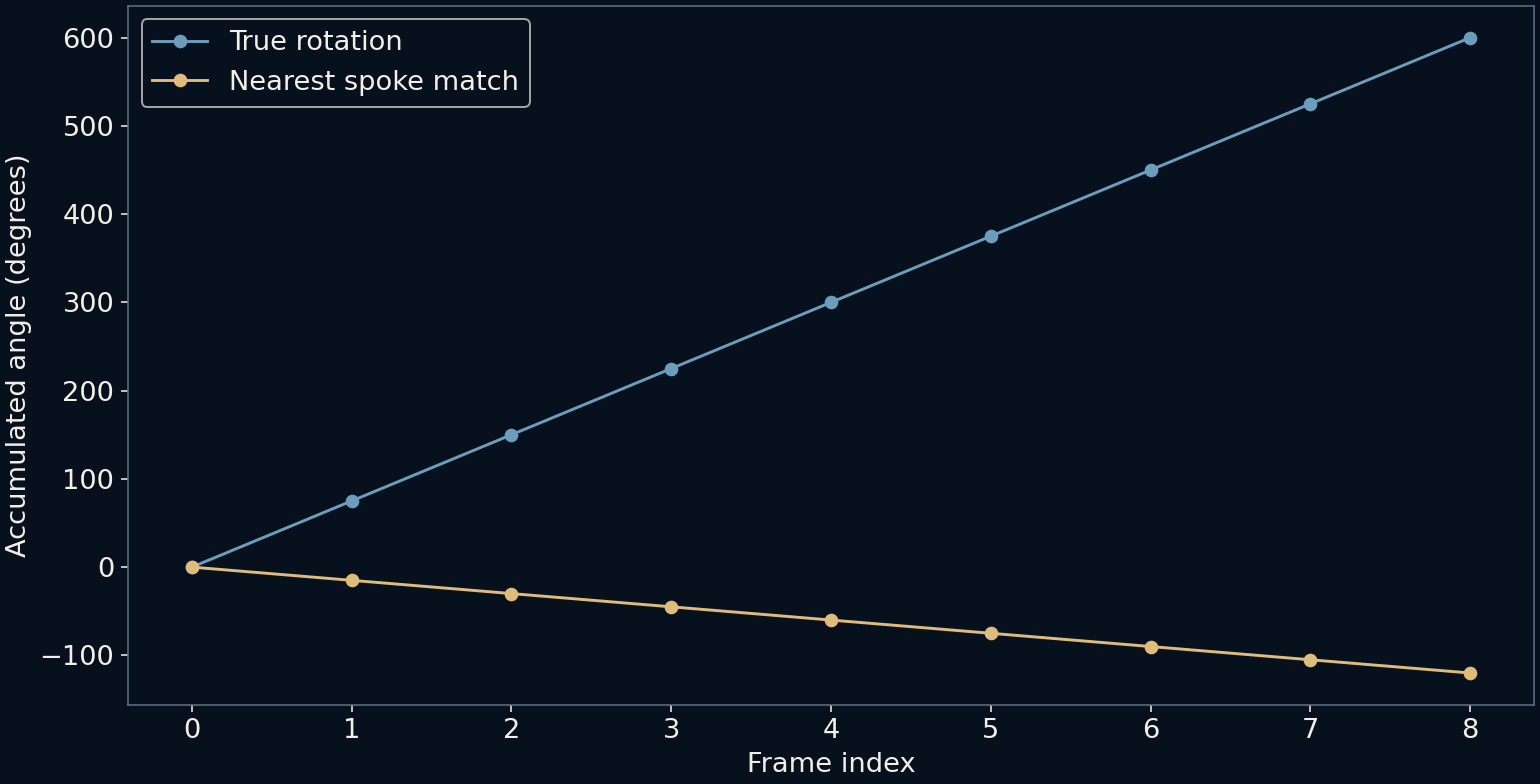
Now sample a wheel rotating at five revolutions per second with 24 frames per second. Between frames it advances 75 degrees. The next picture can also be explained by a 15-degree backward turn, because 75 degrees forward and 15 degrees backward differ by exactly one 90-degree spoke interval.
A complete backward explanation fits
Link each spoke to the nearest matching spoke in the next frame and the wheel appears to retreat by 15 degrees per frame. At 24 frames per second, that is 360 degrees backward every second: an apparent speed of minus one revolution per second. The script confirms identical sampled spoke orientations for the two motions.
This is temporal aliasing. A repeated structure is observed too sparsely to distinguish different motions that fit the same observations. The apparent backward motion is not simply a random mistake. It is a mathematically consistent alternative explanation of the sampled images, although it is not the motion used to generate them.
The sampling rate sets a repeating ambiguity
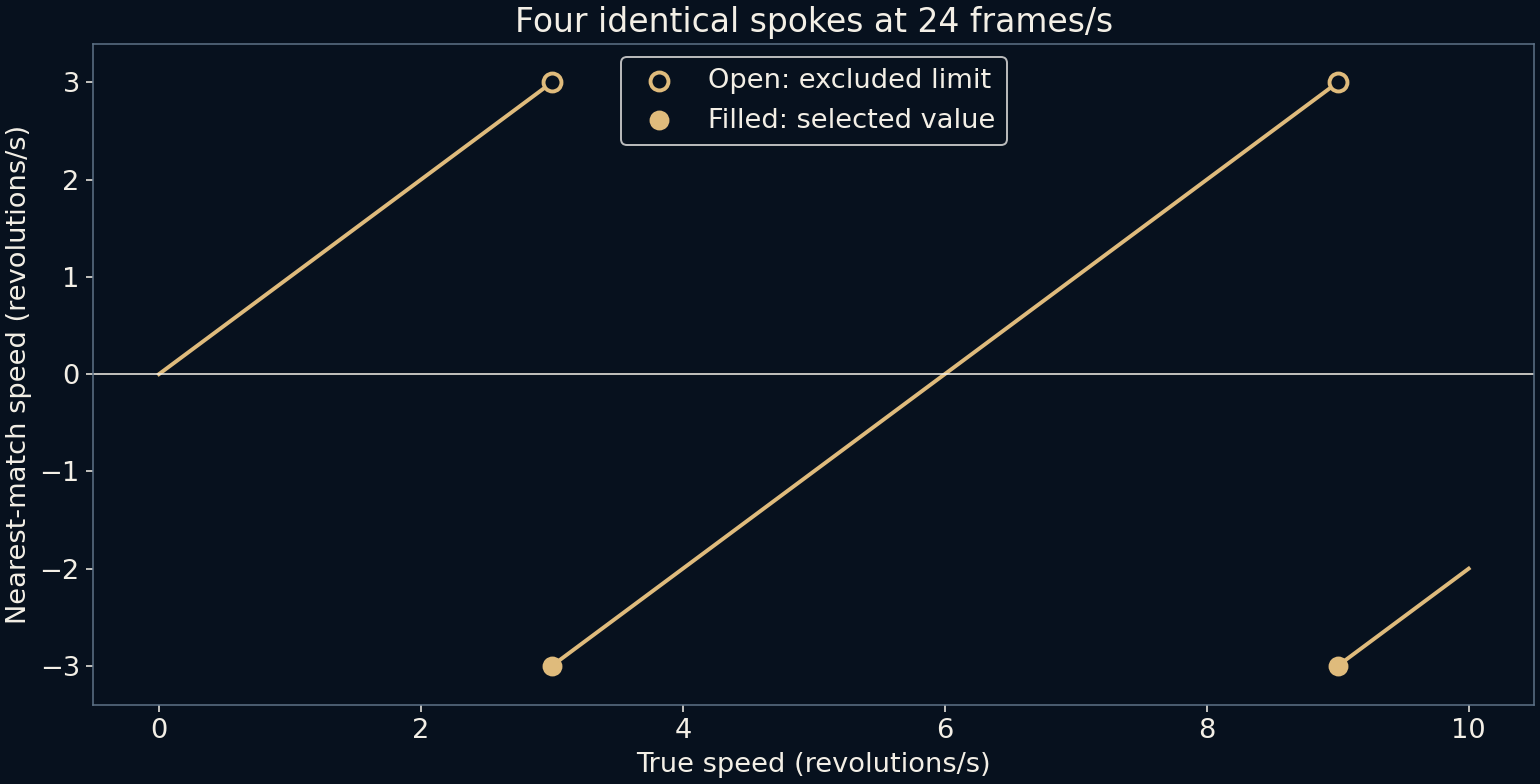
A four-spoke wheel turning five times per second produces a pattern frequency of 20 spoke passages per second. Sampling at 24 frames per second cannot uniquely distinguish that from a pattern moving backward at four passages per second. Dividing by four spokes gives the apparent minus-one-revolution speed.
The speed plot chooses the nearest apparent motion, wrapping the observed pattern frequency into the interval around zero. As true speed increases, the chosen apparent speed repeatedly jumps. These jumps belong to this interpretation of identical snapshots; they do not imply sudden changes in the simulated motor or a universal description of what every viewer perceives.
A shutter has a duration, too
The illustration treats every frame as an instantaneous sample. Real cameras collect light during a finite exposure. Motion during that interval smears edges and can weaken the sharp spoke pattern. A longer exposure may make the alias less conspicuous, but it also removes detail about where the spokes were at a particular instant.
Frame rate and shutter time therefore answer different questions. Frame rate controls how often the scene is sampled. Exposure duration controls how much motion is averaged within each sample. Changing one without checking the other can produce a different-looking wheel without necessarily recovering the missing movement accurately.
The scene can supply extra clues
A distinctive mark, an irregular spoke layout or visible tire texture can break some of the symmetry. Acceleration across many frames may also offer context. Conversely, repeated patterns elsewhere in a scene can produce related ambiguities. Conveyor belts, rotating fans and flashing lights can all interact with a recording or display cadence.
Real footage introduces further complications: rolling shutters sample different rows at different times, compression changes details and lighting can flicker. None of those mechanisms is needed for the four-spoke example. Keeping them separate helps avoid attributing every strange moving shape to the same cause merely because the final image looks unusual.
Ask what could happen between frames
A sequence of clear pictures can still leave motion uncertain. Sharpness within a frame does not guarantee enough observations over time. This is the temporal counterpart of a finely striped texture producing false broad bands when sampled on a coarse pixel grid.
When a movement looks implausible, compare the repetition rate of the subject with the sampling rate, and look for distinctive features that survive from frame to frame. The important question is not only what each image shows, but how many different journeys could connect those same images.
Further reading
MIT OpenCourseWare: Sampling ↗Stanford CCRMA: Sampling theorem ↗Original documentation and useful background.