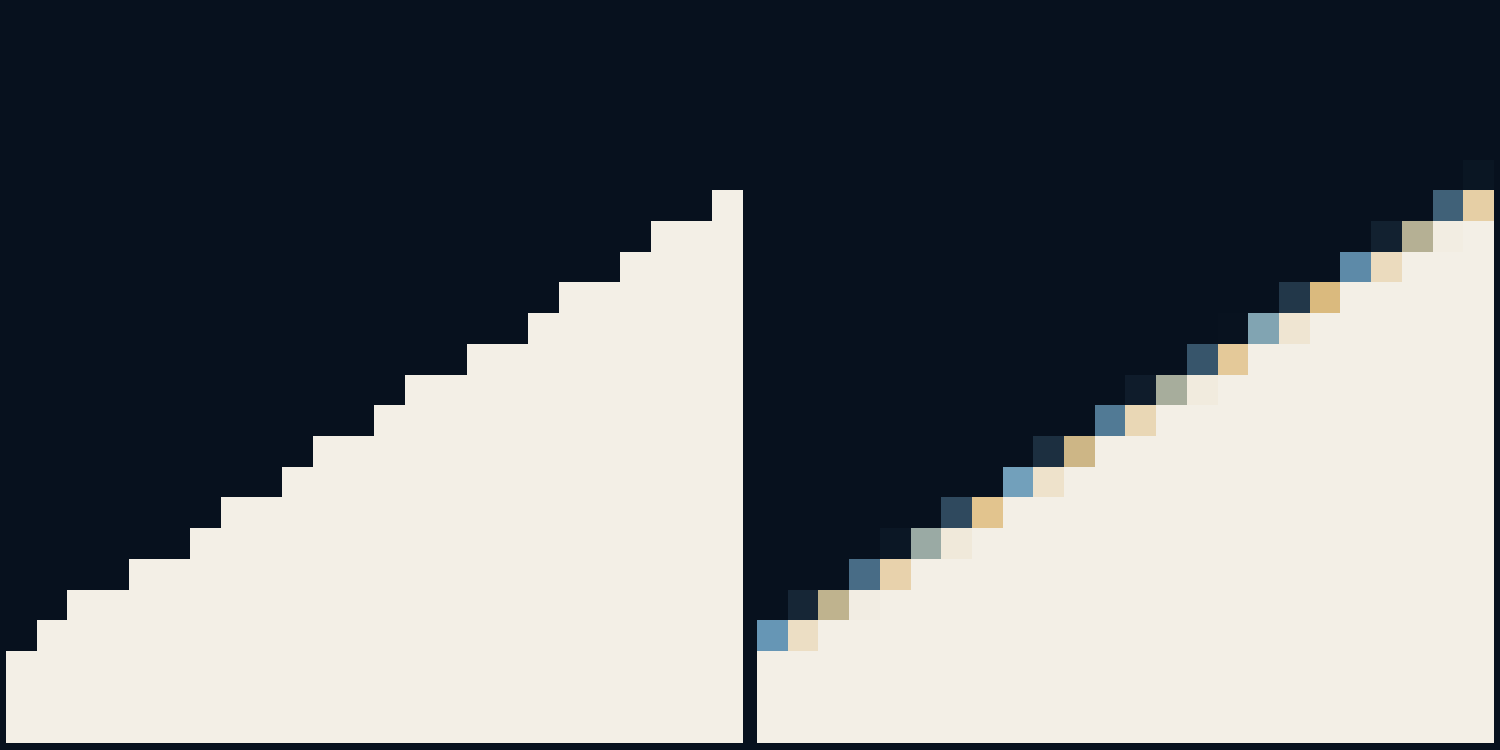
Why does a slanted edge look rougher than a horizontal one?
A diagonal cuts across a square grid awkwardly. Some squares lie entirely on one side; others are divided by the edge. If every square must choose only black or white, the boundary jumps in steps. Antialiasing begins by asking a better question about those partly covered squares.
An edge can cover half a pixel without becoming half an edge.
The square that contains two answers
Imagine a white sheet covering part of a dark table. A pixel sitting fully inside the sheet should be white, and one fully outside should be dark. At the boundary, the sheet may cover only a fraction of the pixel. A binary decision based on the center ignores everything else inside that square.
A coverage estimate records the fraction instead. A quarter-covered pixel contributes one quarter of the foreground in an ideal linear-light compositing model. Intermediate brightness near an edge need not describe a fuzzy object. It can describe a sharp object whose boundary passes through a finite measurement area.
Make a deliberately small image
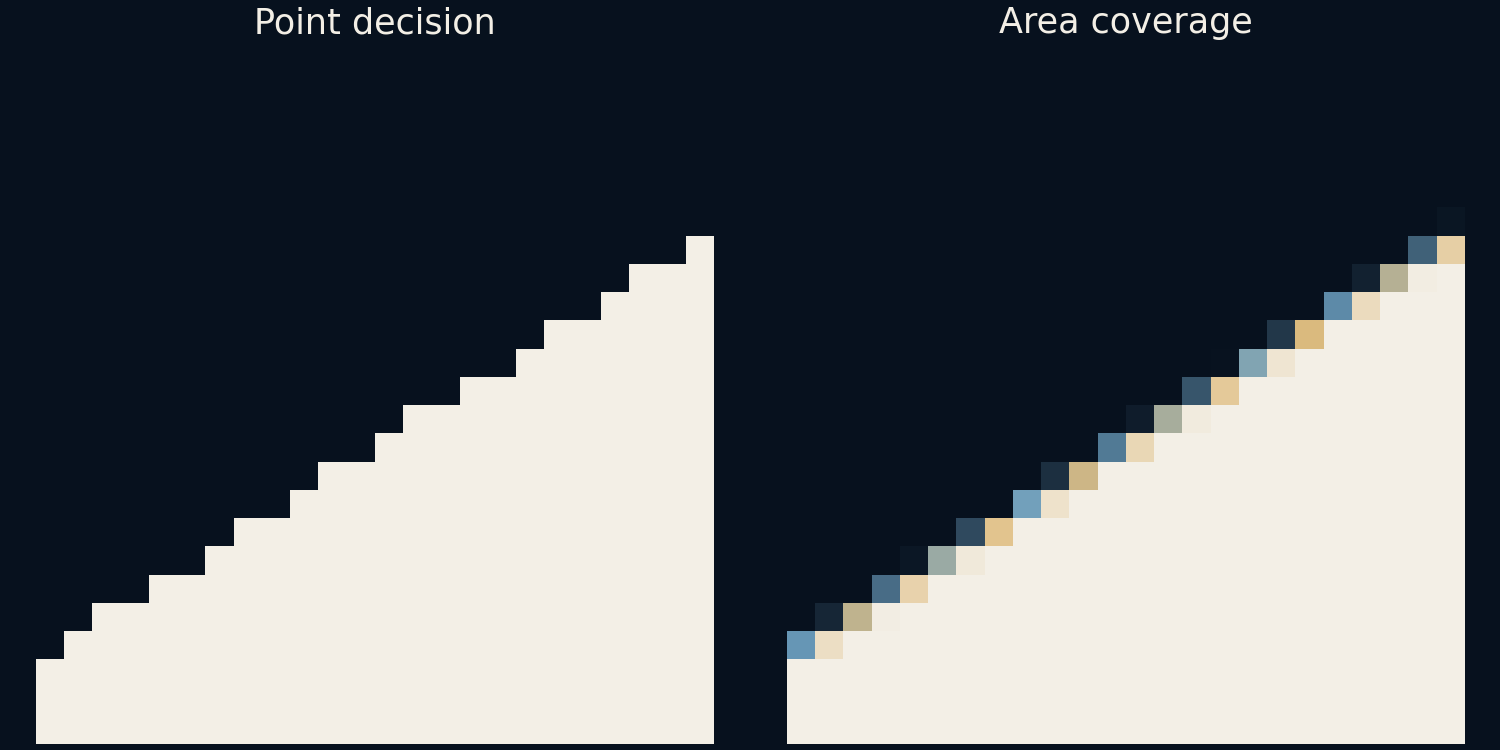
Our synthetic image has only 24 by 24 pixels. The white region lies below the straight line y = 0.63x + 3. One version tests only the center of each square. The other divides each pixel into a 32 by 32 arrangement of evenly spaced sample points and averages their inside-or-outside decisions.
That gives 1,024 subsamples per pixel, but it does not create 1,024 independently displayable pixels. They are used to estimate one coverage value. This is a finite numerical approximation to area, not an exact analytic integration. Increasing the subsample count can refine the estimate without changing the final image dimensions.
The grey squares carry position
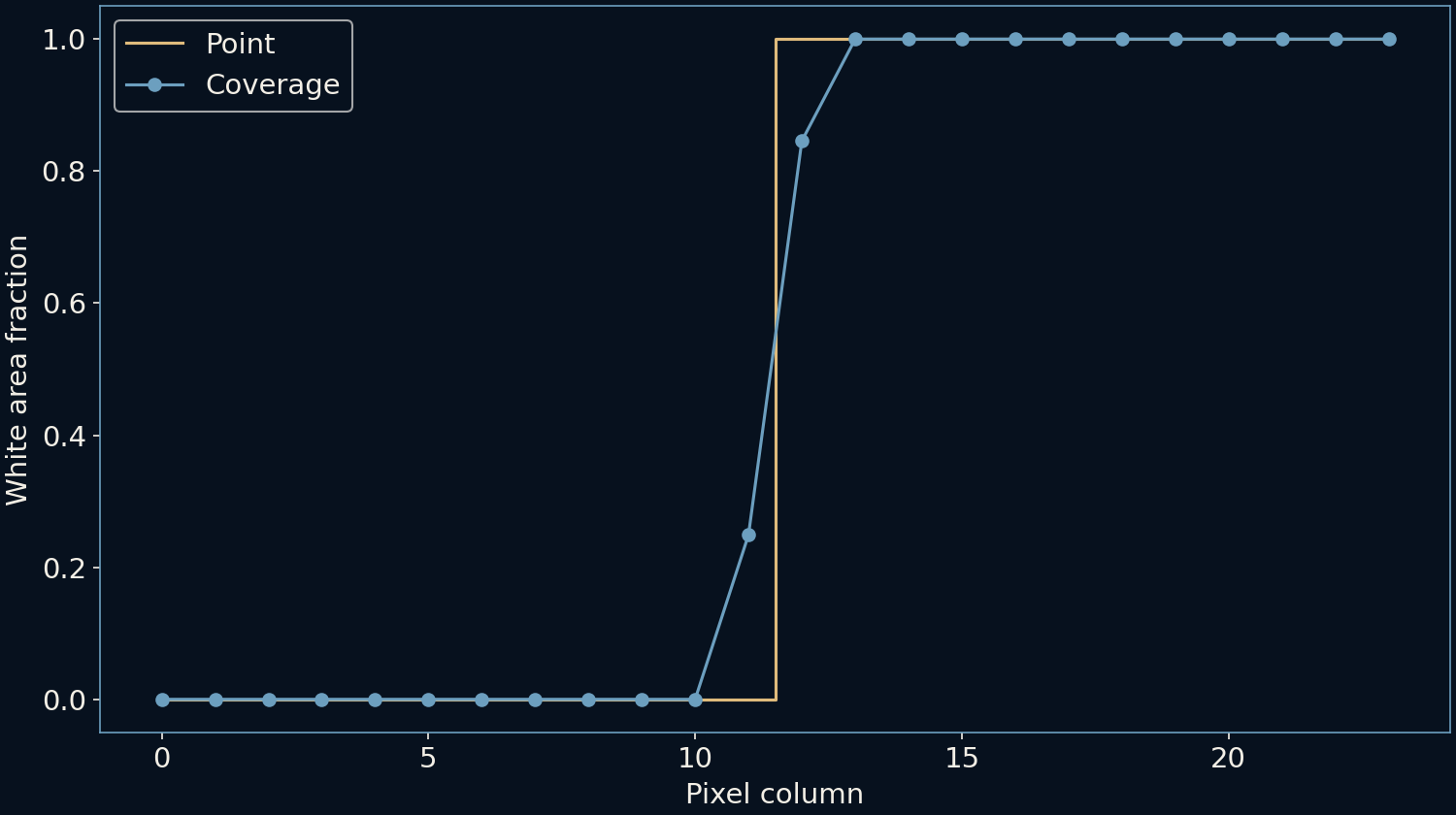
In the enlarged comparison, the center-tested edge switches abruptly between full values. The coverage version has a narrow band of intermediate values. Those values convey where the boundary crosses each square. If the edge moves a little, coverage can change gradually even while the set of pixel centers on either side remains unchanged.
The row plot isolates this difference. It is easier to read than a whole diagonal because each column now has an explicit number. The staircase has not physically disappeared from the display grid. Instead, the brightness pattern gives the visual system more evidence about the location of the continuous edge.
Movement exposes the lost information
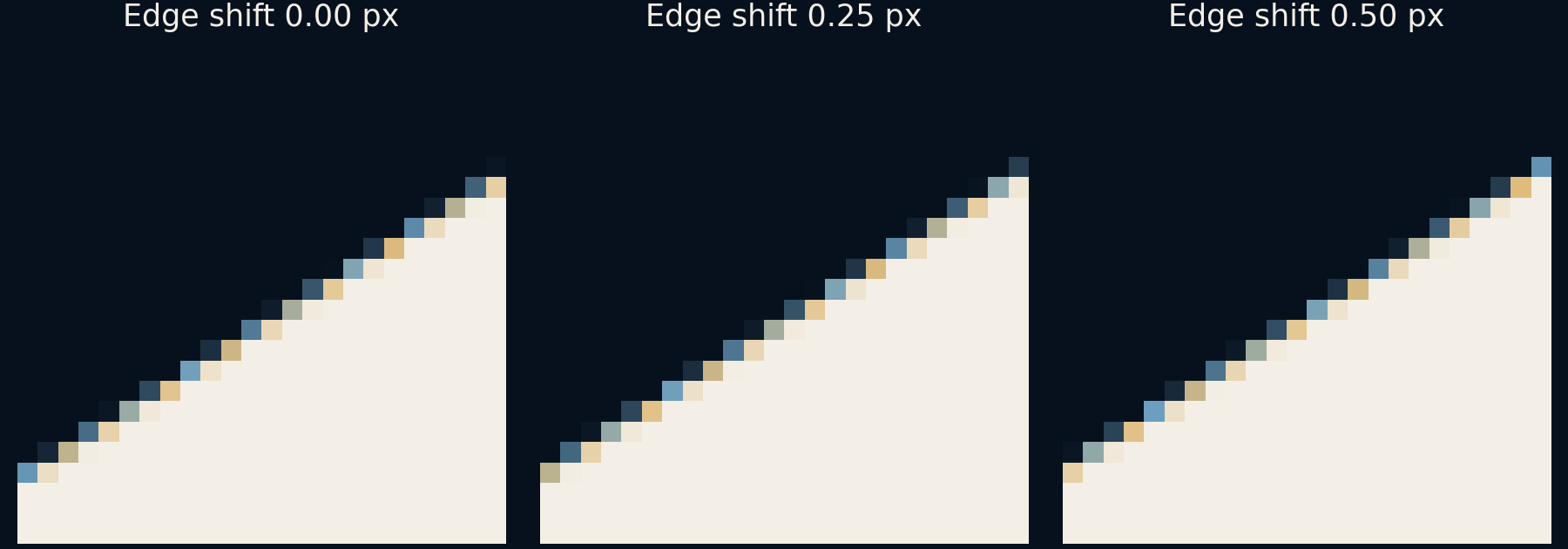
A second comparison shifts the edge upward by zero, a quarter and half a pixel. The geometry changes smoothly. The coverage values respond across the boundary rather than waiting for a center point to cross. This helps explain why antialiasing matters in animation as well as still images: binary decisions can turn gentle movement into sudden flicker.
Our pictures are static samples of those positions, not a measured animation benchmark. A moving scene can also require filtering over time. Spatial coverage by itself does not solve temporal aliasing, motion blur, transparency sorting or the many sampling problems introduced by textures and shading.
Brightness needs the right arithmetic
Coverage is a geometric weight, not automatically a display code value. To combine foreground and background light correctly, a renderer should account for the color encoding in use. Simply averaging encoded sRGB numbers can produce a darker transition than averaging linear light and encoding the result afterward.
The diagrams use a navy-to-light visualization so that fractional values are visible; they are not a calibrated display test. Browser scaling can add another filtering step. Inspecting an enlarged image reveals the numerical construction, while judging the edge at normal size asks a separate perceptual question about contrast, viewing distance and the actual screen.
Smoothness is a budget decision
More samples cost computation, and coverage is only one approach. Renderers may use analytic edge calculations, multisampling or carefully designed filters. Different methods make different compromises between cost, detail and stability. A blurry result is not necessarily a better one, particularly when small features need to remain distinct.
The key is to preserve enough information for the question the image must answer. A sharp diagonal should not have to pretend that every square is entirely inside or entirely outside. Once the pixel is understood as an area, the intermediate shades stop looking like a cosmetic trick and start looking like useful measurements.
Further reading
Physically Based Rendering: sampling theory ↗W3C compositing and blending ↗Original documentation and useful background.