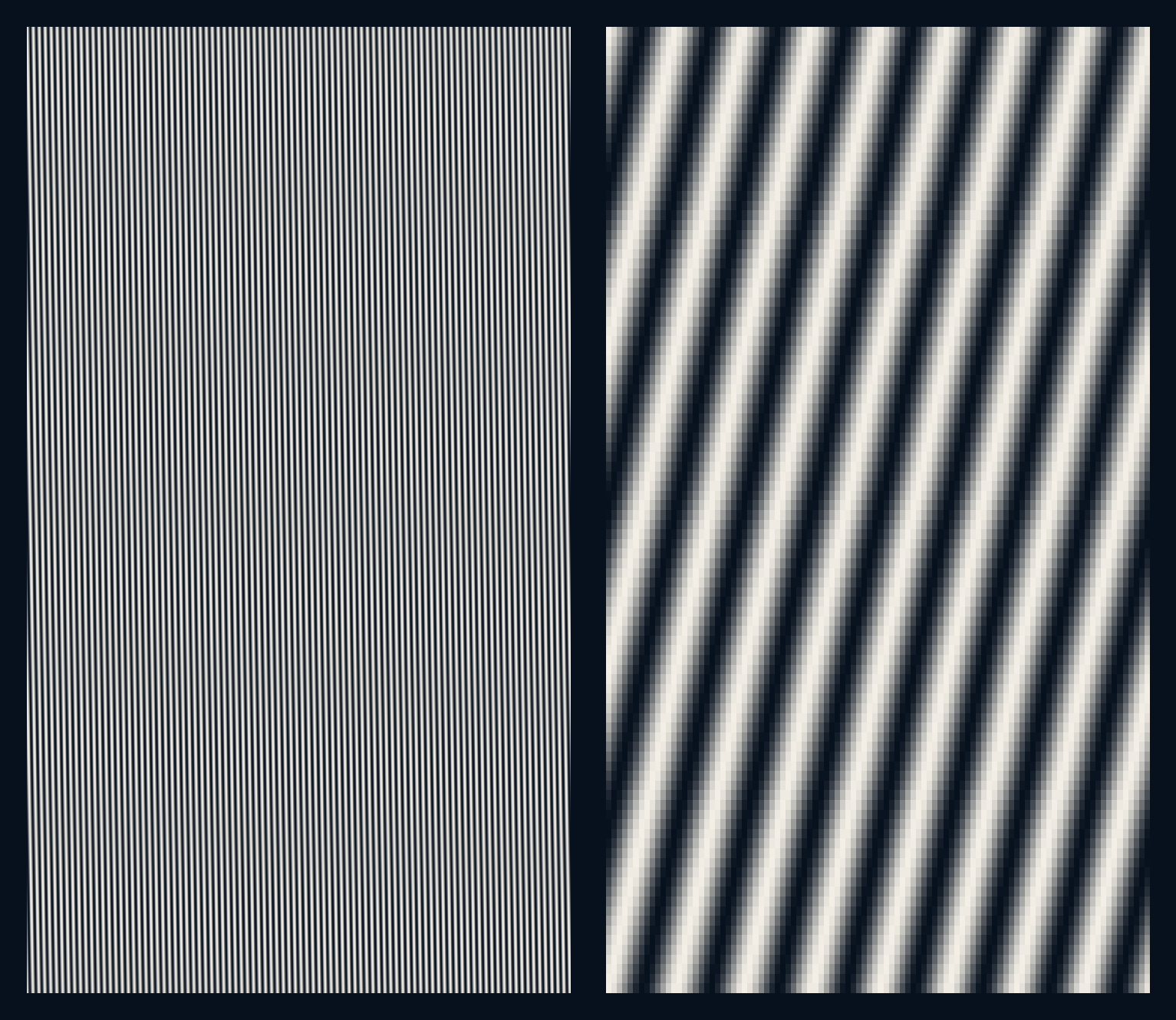
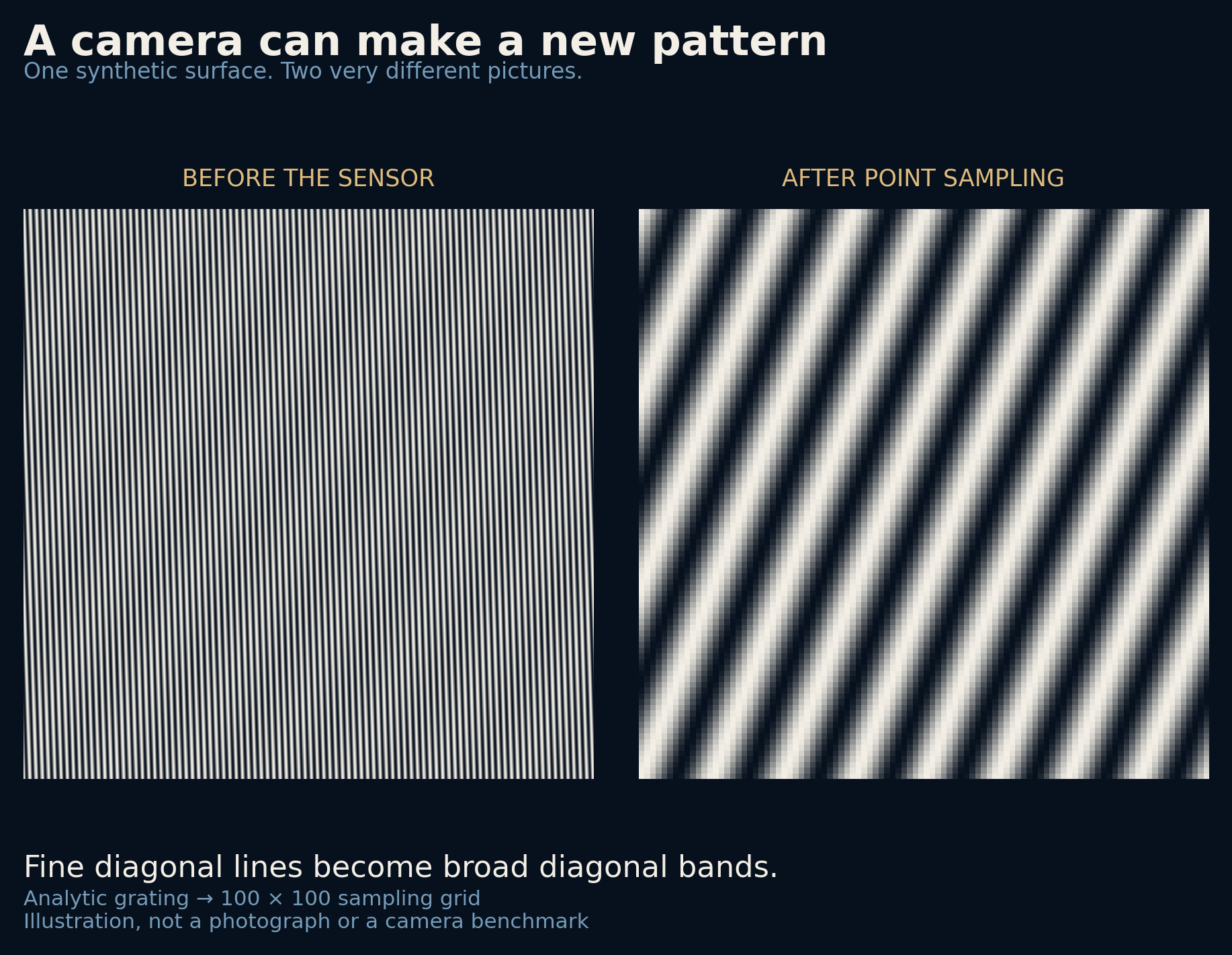
How can a photograph contain stripes that were never on the shirt?
A tightly woven fabric can look perfectly ordinary until a camera turns it into rippling bands. The subject has not changed. The photograph has acquired a new pattern while measuring the old one. This is one route to moiré, and a small synthetic experiment makes the trick unusually easy to see.
A sharp-looking pattern can be the wrong pattern.
The gaps matter as much as the pixels
Imagine measuring a striped surface at regularly spaced points. Each point reports a brightness. It cannot report what happened in the gap before the next point. If the stripes change slowly enough, those measurements describe them well. If many changes fit between the points, another pattern can fit the same evidence.
Real sensor pixels collect light across an area, and lenses soften detail before it reaches them. Our model deliberately starts with the simpler case: perfect point samples and a monochrome pattern. It leaves out those protections so that the ambiguity is visible on its own.
Two different waves can leave the same dots
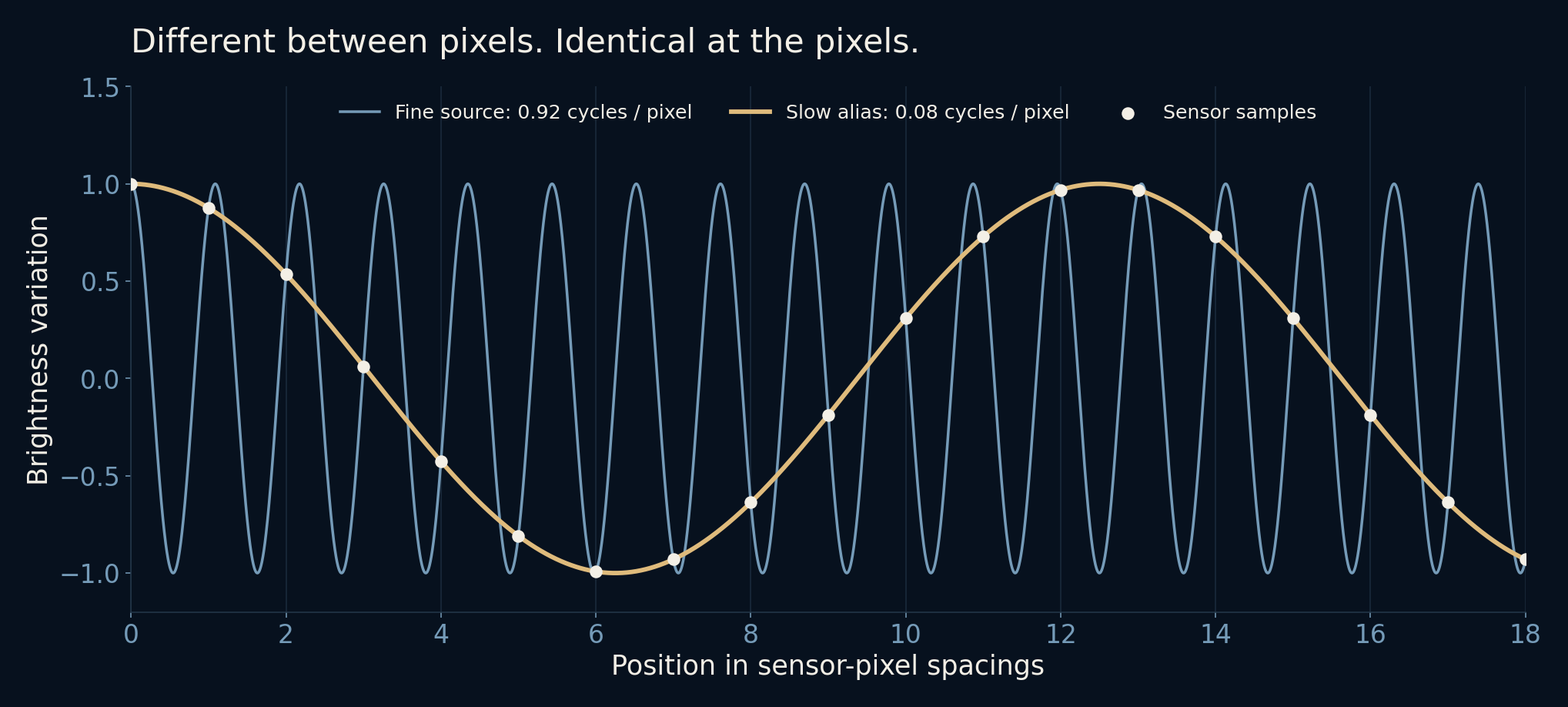
In the line plot, the blue wave repeats 0.92 times per pixel spacing. The gold wave repeats only 0.08 times. One is busy; the other moves slowly. Yet at every integer pixel position, their brightness values agree. Between the sample points they tell completely different stories.
This is aliasing: different signals acquire the same sampled identity. For a simple, regularly sampled brightness signal, frequencies must stay below half a cycle per sample to avoid this ambiguity under the usual band-limited assumptions. Our 0.92-cycle pattern exceeds that boundary and appears as a much slower variation.
The false pattern has a direction
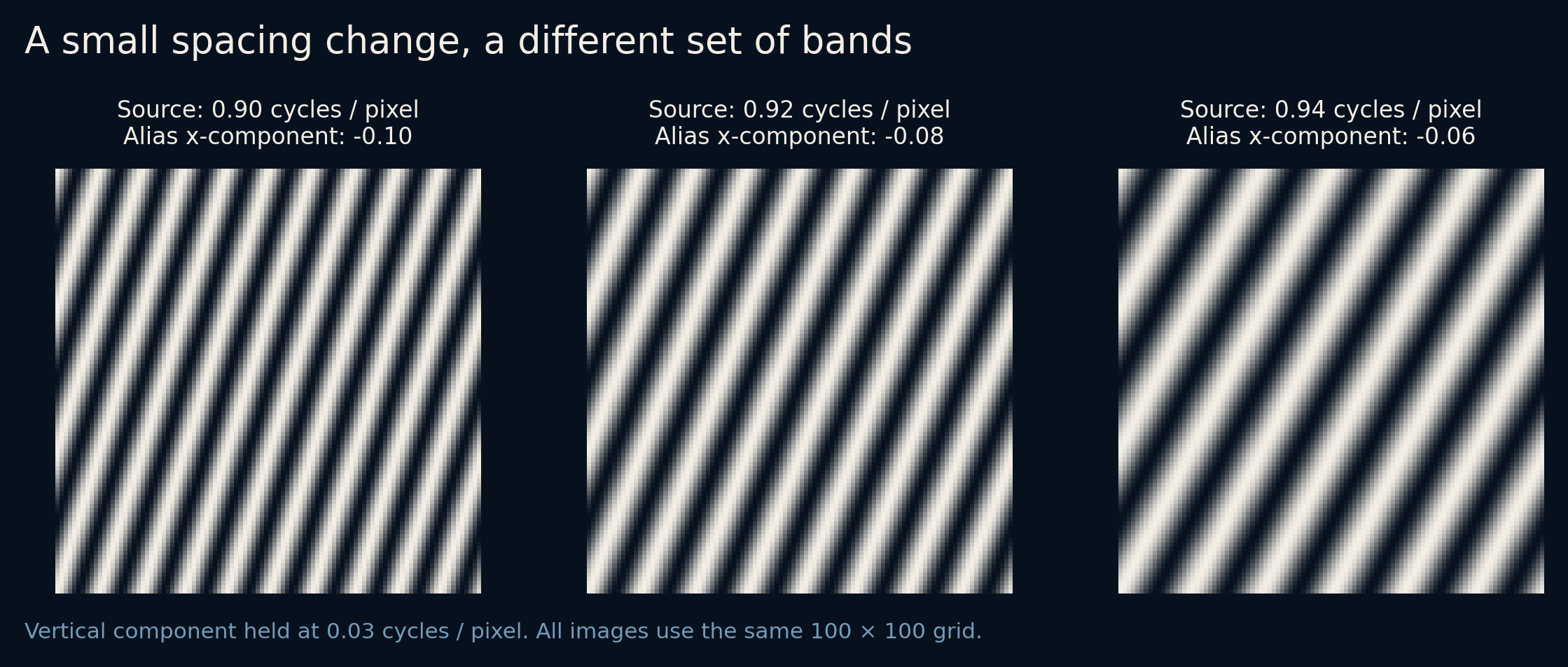
Now extend the line into a surface. The generated grating advances 0.92 cycles per horizontal pixel and 0.03 per vertical pixel. Sampling on a 100 × 100 grid produces the same values as a broad grating with components −0.08 and 0.03. That changed relationship also changes the apparent angle of the bands.
The next image changes only the horizontal component, from 0.90 to 0.92 to 0.94. Each small adjustment produces a different broad pattern on the same grid. This helps explain why a slight change of framing can make moiré move dramatically. The experiment demonstrates the mechanism, not the response of a particular lens or camera.
Blur can preserve a more truthful picture
The surprising defense is to remove some fine detail before sampling. An optical low-pass filter does this physically in some cameras. A digital low-pass filter can do a related job before an image is reduced in size. Both aim to keep unsupported detail from returning disguised as something larger.
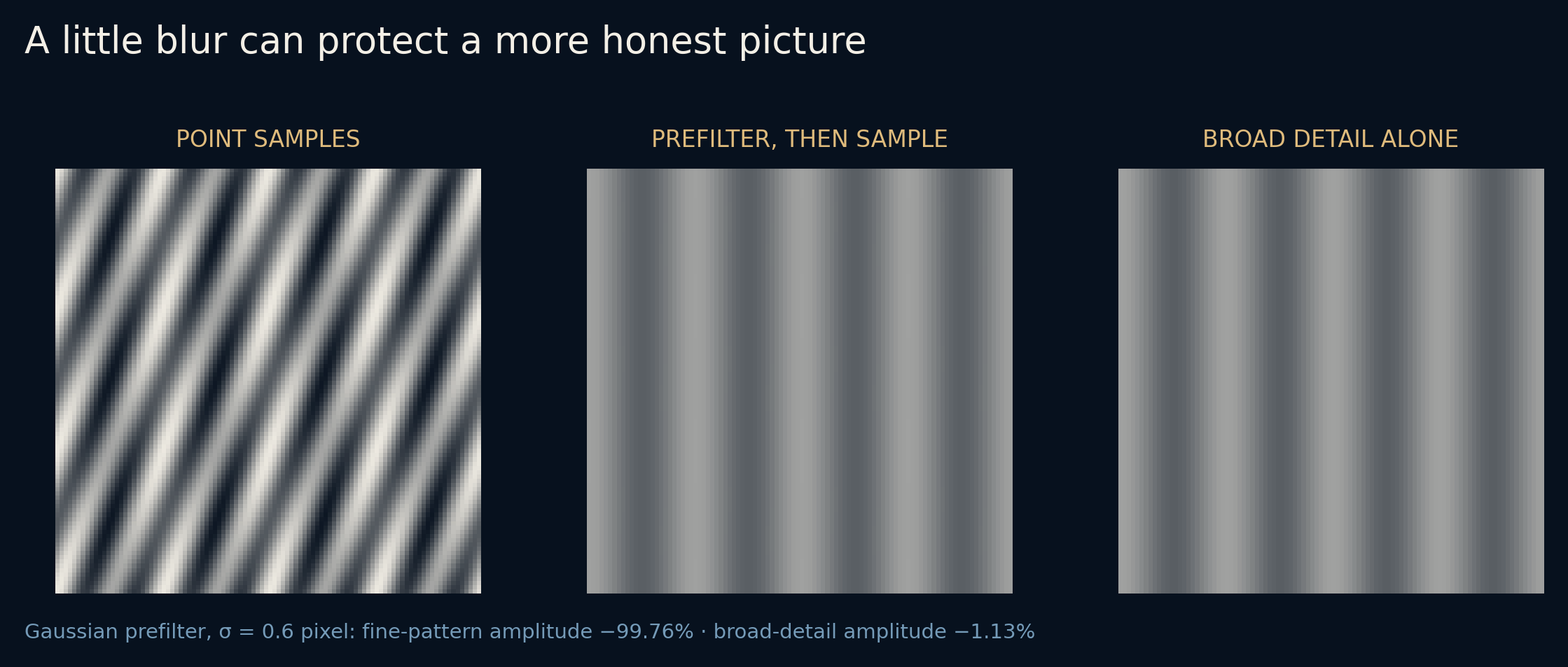
For our second synthetic surface, we add genuine broad shading to the fine stripes. An ideal Gaussian prefilter, with a width parameter of 0.6 pixel, reduces the fine-pattern amplitude by 99.76% while retaining 98.87% of the broad shading amplitude. These are measured properties of this constructed signal, not promised camera improvements.
The order matters. After the samples have confused the two patterns, blurring cannot know which variation was real. Filtering first can prevent the confusion; filtering later may simply make the false bands softer.
What to try when fabric starts rippling
A small change in distance, focal length or camera angle may change how a repeating texture meets the sensor grid. Check the result rather than assuming the change will help. A different framing can move the problem, reduce it or produce a new pattern. Review the original file as well as the resized preview, because resizing is another sampling step.
Color adds further complications. Many cameras measure different colors at neighboring sensor sites and estimate the missing values. Fine textures can therefore acquire false colors as well as false brightness bands. Our grayscale demonstration does not simulate a color-filter array, demosaicing, sharpening or any manufacturer’s processing.
More visible detail is not always more information
Moiré is unsettling because the result can look organized and confident. The broad stripes are easy to see. Their clarity does not make them faithful. A recording system can produce a persuasive structure precisely because it did not collect enough information to distinguish the alternatives.
The useful habit is to ask what was measured, at what spacing, and what was removed before measurement. Those questions matter whenever a continuous world becomes a grid. Sometimes the more honest image is the one that gives up a little sharpness.
Further reading
Nikon · Moiré & False Color ↗NI · Sampling, bandwidth and aliasing ↗NumPy · Discrete Fourier Transform ↗All illustrations were generated from the local calculation. Dense patterns may acquire additional artifacts when your screen or browser resizes them.