
Why does an unfocused lamp become a glowing disc instead of merely a dimmer point?
Focusing a lens means choosing where rays from one object distance meet the image plane. Rays from other distances generally meet somewhere else. When the sensor intercepts them too early or too late, a point spreads into a small shape. A thin-lens calculation makes that blur measurable without testing a camera or judging anyone’s photographs.
Focus is a meeting place for rays.
Choose one plane to be sharp
The thin-lens equation relates focal length, object distance and image distance: the reciprocal of focal length equals the sum of the other two reciprocals. Our lens has focal length 50 millimetres and is focused at two metres. Keeping all calculation lengths in millimetres places the sensor about 51.282 millimetres behind the ideal lens.
This model treats the lens as an infinitesimally thin optical element and uses paraxial geometry. Real photographic lenses contain multiple elements, principal planes, aberrations and focusing mechanisms. The simple equation is useful for understanding the geometry, but the numbers are not a calibration for a particular lens barrel or camera body.
The aperture sets the cone's width
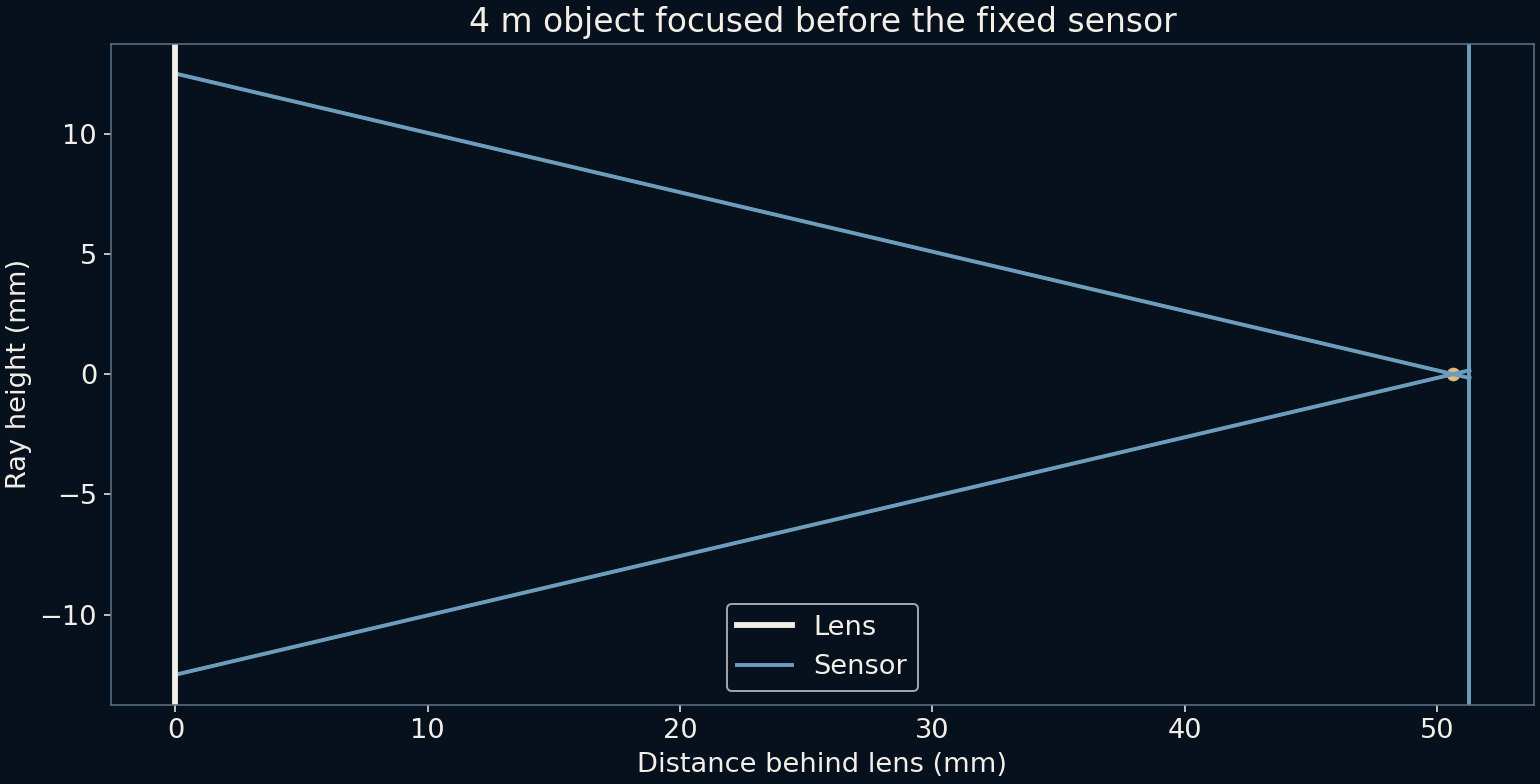
For a point on the optical axis, rays passing through different parts of the aperture converge toward an image point. If that point lies away from the fixed sensor, the sensor cuts through a cone of rays. With an ideal circular aperture, the cross-section is a circle of confusion, a name for the geometric blur disc.
The f-number is focal length divided by entrance-pupil diameter in this simplified model. At f/2, the 50-millimetre lens uses a diameter of 25 millimetres. At f/8, it uses 6.25 millimetres. A smaller opening produces a narrower cone and a smaller out-of-focus cross-section for the same object and sensor positions.
The cone gives a direct calculation rather than only a picture. If A is aperture diameter, v is the image distance required by the object and v₀ is the fixed sensor distance, the blur diameter is A times the absolute value of 1 − v₀/v. Similar triangles supply this ratio. A diameter is being calculated, not a radius, and all three lengths must use the same unit.
Put numbers on the circles
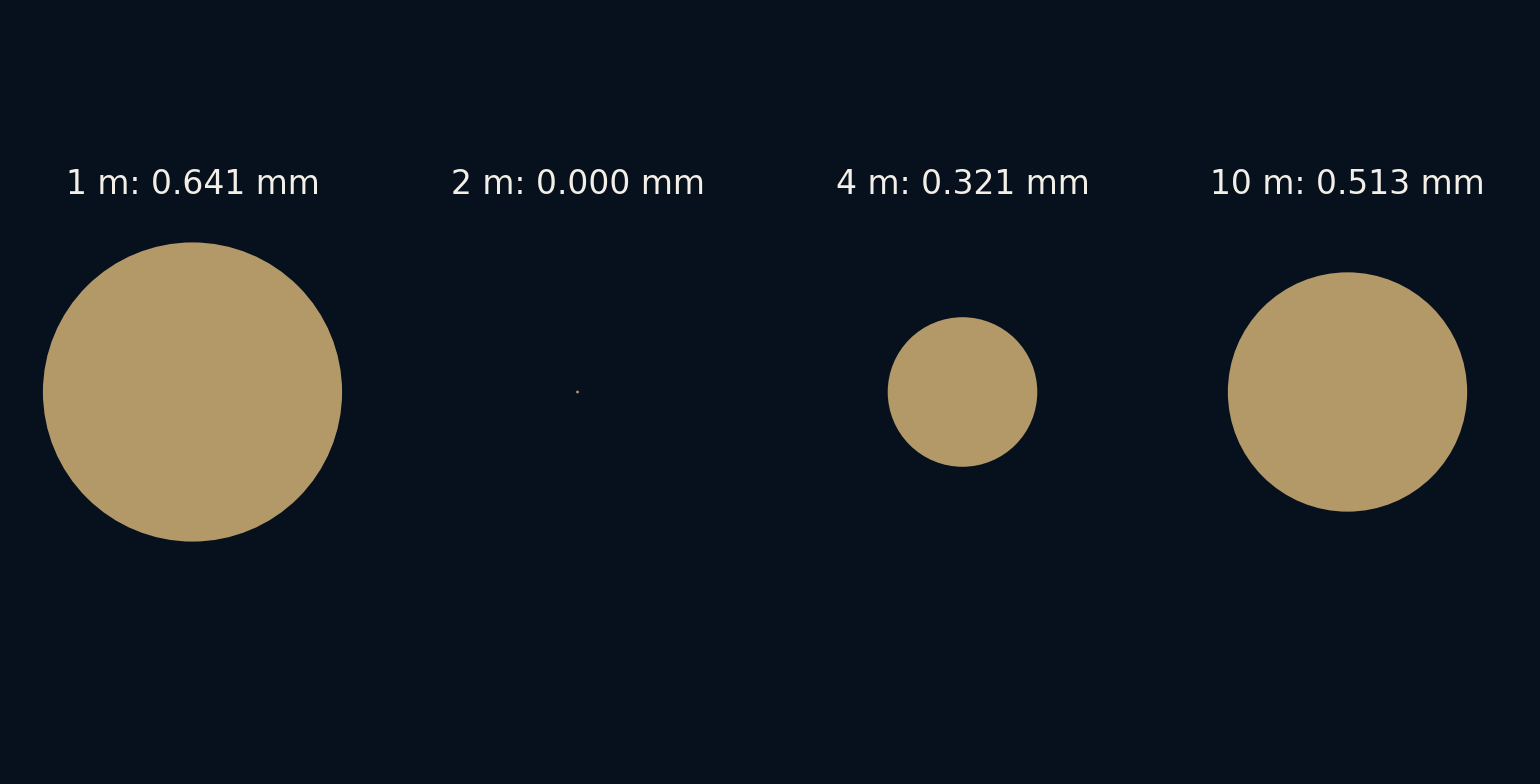
With focus fixed at two metres and aperture f/2, a point one metre away produces a geometric circle diameter of about 0.641 millimetres on the sensor. A point four metres away produces about 0.321 millimetres, and one at ten metres produces about 0.513 millimetres. The point at the focus distance has zero geometric diameter in this model.
At f/8, each of those diameters is one quarter as large because the aperture diameter is one quarter as large. The four-disc comparison uses a common geometric scale, with a tiny display marker for the focused point so its location remains visible. It is not a photograph of bokeh or a prediction of perceived sharpness on a particular screen.
Near and far do not behave symmetrically
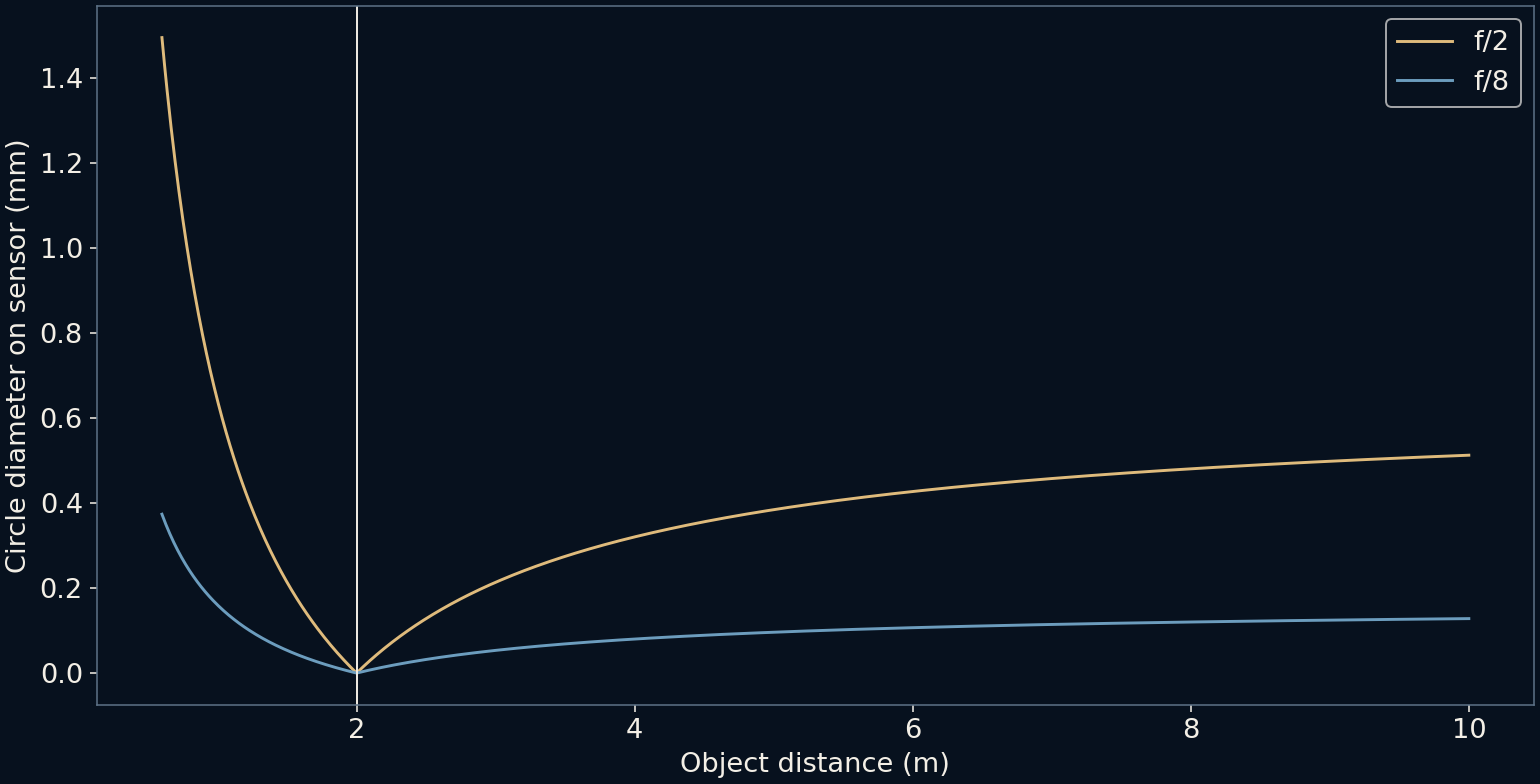
The blur curve reaches its minimum at the focus distance, but it does not form a symmetric bowl around two metres. The thin-lens relationship depends on reciprocal distance. Moving an object one metre nearer and one metre farther therefore does not produce equal image-plane displacement or equal blur circles.
For objects very far away, the required image distance approaches the focal length. The far-background blur in this model approaches a finite limit rather than increasing without bound. This is one reason simple rules based only on the number of metres between subject and background can be misleading when the camera geometry changes.
Combining the lens and cone equations makes the asymmetry explicit. For focal length f, focus distance s, object distance z and f-number N, the diameter is f²/[N(s − f)] times |1 − s/z|. At infinity, the final factor approaches one. With our 50-millimetre lens focused at two metres, that limiting diameter is approximately 0.641 millimetres at f/2, even though the background distance keeps increasing.
Depth of field needs an acceptable blur threshold
Only one object plane is perfectly focused in the ideal geometric calculation. Depth of field describes a range judged sufficiently sharp under a chosen criterion. That criterion depends on the final display or print size, viewing distance, sampling and the viewer's requirements. There is no universal circle diameter that makes every photograph acceptable.
Stopping down can increase the range meeting a chosen geometric threshold, but real optics introduce diffraction as the aperture gets smaller. Motion blur and sensor noise can also matter when exposure settings change. Our calculation omits these effects, so it does not support the claim that the smallest aperture always makes the sharpest image.
A sensor-pixel count cannot supply that viewing criterion by itself. For example, a hypothetical pixel pitch of 0.004 millimetres makes a 0.030-millimetre blur diameter span 7.5 pixel pitches. That is a size conversion, not an assertion that seven or eight pixels are acceptable. Enlarging the final image also enlarges the blur, while a smaller presentation can hide details visible under close inspection. State the intended use before choosing the threshold.
The circle carries the aperture's signature
A real out-of-focus point can resemble the opening through which its rays passed. Aperture blades, optical vignetting, aberrations and image position can alter its shape and brightness distribution. The clean circle is an ideal starting point rather than a complete account of the aesthetic qualities often grouped under the word bokeh.
The practical lesson is geometric: focus distance fixes the image plane, aperture controls the cone width and object distance determines where each cone would meet. Once those three roles are separated, the background's soft discs become less mysterious. They are records of rays that reached the sensor without meeting there.
Turn “sharp enough” into a stated range
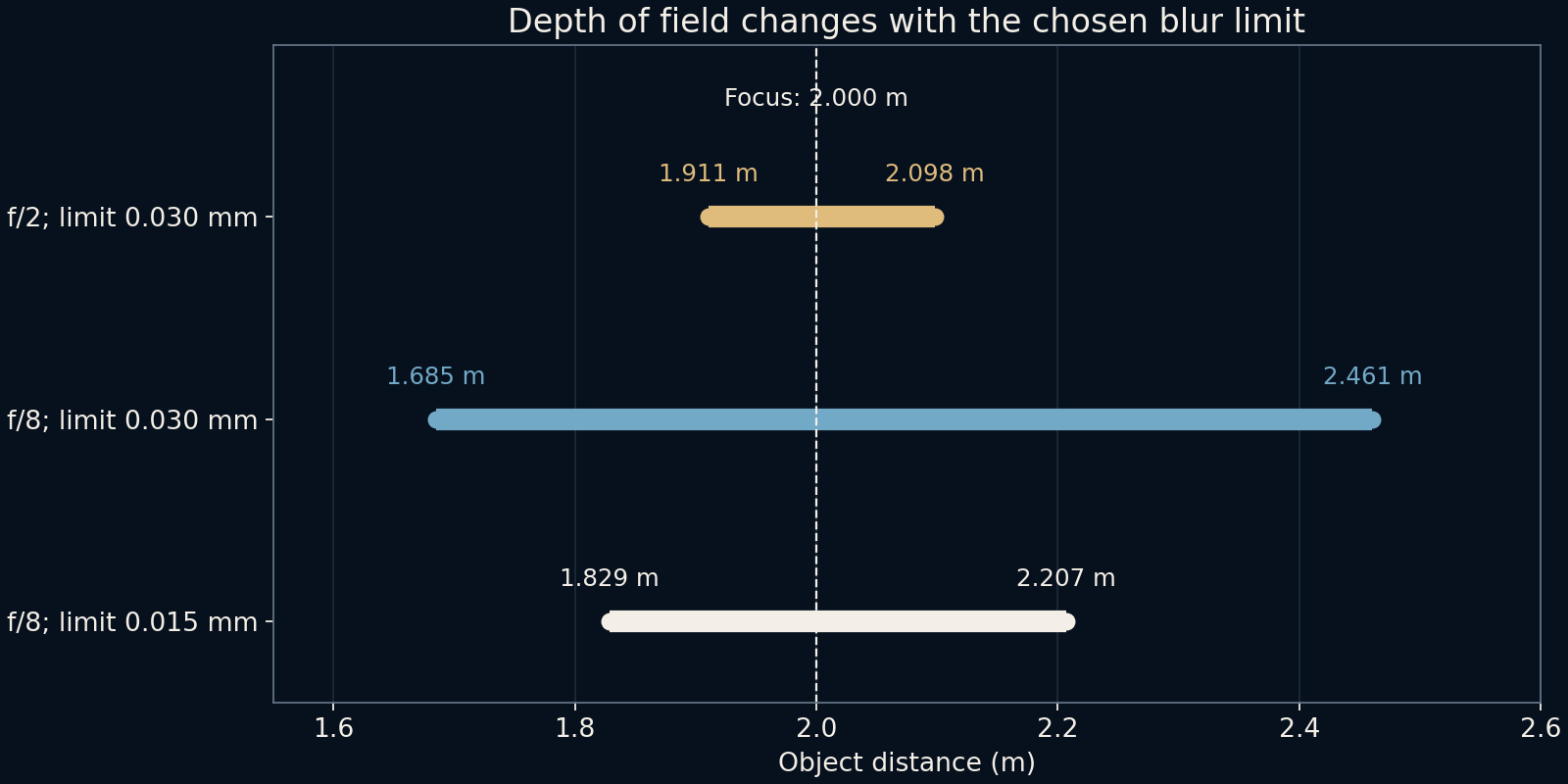
Suppose we deliberately choose a sensor-plane blur limit of 0.030 millimetres. Solving the same equation on either side of the two-metre focus distance gives a near boundary of 1.911 metres and a far boundary of 2.098 metres at f/2. The acceptable interval is about 0.188 metres wide. These endpoints are computed from the chosen limit; they are not two additional planes of exact focus.
At f/8, keeping the lens, focus distance and threshold unchanged expands the interval to approximately 1.685–2.461 metres. Now tighten the threshold to 0.015 millimetres without touching the camera geometry. The f/8 interval contracts to about 1.829–2.207 metres. The illustration separates those two decisions: changing the aperture alters the rays, while changing the threshold alters which blur sizes the reader agrees to count as sharp enough.
This is a useful way to read a depth-of-field estimate. Check its focal length, focus distance, aperture and blur criterion before comparing two ranges. If a group extends in depth, test the nearest and farthest important points rather than assuming equal tolerance in front of and behind the focused subject. Real lens performance and movement still need separate consideration. A computed interval organizes the decision; it cannot replace a check of the intended final image.
Further reading
PBRT: Projective camera models ↗OpenStax: Thin lenses ↗Original documentation and useful background.